Showing posts with label Genesis. Show all posts

Friday, March 7, 2014

Old Testament Lesson 10: Birthright Blessings; Marriage in the Covenant

"True Love!Is the greatest thing in the world!" The Princess Bride
Many of us remember fondly the movie The Princess Bride and its search for true love. The world today would have us believe that true love is romance and physical attraction. What we will learn of in this week's study is the biblical version of true love - love that is often found through duty and service first. It certainly is not short on physical attraction but true love focuses more on the lasting beauty within, than the physical and fading beauty without. It is also not the fairytale romance that Hollywood and the media would have us believe it should be, where all things are simple and easy. Instead it takes patience and tolerance and often great heartache and sorrow. True love develops gradually, building act upon act, day upon day, year upon year.
In the lives of Isaac and Rebekah, Jacob and Rachel and Leah we find moments of magical romanticism and at other times instances of stoic yet sorrowful hardship. Couple this with the blessings of the covenant of eternal marriage and we discover a path that, though at times testing and tough, is ultimately beautiful and rewarding and true.

Genesis 24
v. 1-10
Abraham being "old and well-stricken in age" makes it sound as though he is dying. He is actually around 140 yrs old and would live another 35 years, marry one more time and have another 6 children. What do you plan to do in your retirement?!
"Said unto his eldest servant of his house who ruled over all that he had..." This servant proves to be wise, inspired of God and faithful. We never are told his name in this passage but his example lives on as someone who we can all aspire to be.
In the symbolism of this story, who is the master and who is the eldest servant with whom the keys of the kingdom (all that his master hath) are entrusted and is asked to ensure the exaltation of his children (son)?

So part of Abraham's retirement plans was to instigate a search for a wife for Isaac with these conditions:
  •  not to marry a daughter of the Canaanites
  •  from my country and kindred take a wife for my son
  •  do not take my son to the old homeland
  •  if no woman follows you back, you are cleared of this promise but just never take Isaac back to that land.
Why is Abraham so insistent on Isaac not marrying a Canaanite?  He wants Isaac to have the blessings of eternal marriage which is the blessings of eternal increase and seed. He could be happily married by contract but it would not be in the covenant and would miss out on the eternal blessings promised to Adam and Eve, Enoch, Noah, and Abraham etc. Also the Canaanites were in general a wicked people who worshiped idols and believed in witchcraft. If we unite with these practices it is very hard to keep ourselves unstained from them.

The servant is sent on his search with 10 camels loaded with Abraham's wealth. Presumably much of this was as a dowry for the bride's family.
v.11-14 bold and very specific prayer. Do we ever pray like that?
v.15 Rebekah, Abraham's grand-niece and Isaac's first cousin once removed.
“Rebekah is unique among the wives of the patriarchs in at least two ways. First, she alone has a consistently monogamous marriage; we know of no other woman who married Isaac. Second, she plays a more active role in the Genesis narrative than her patriarch husband; her individuality and vitality among the covenant people is striking in stories of her qualifying as Isaac’s wife, receiving revelation from God for their sons, and ensuring the bestowal of the birthright on Jacob, as God intended… By contrast, Isaac is remarkably passive in the narrative.”
“Resolute in her duties, Rebekah demonstrated her faith in God by an unflinching commitment to act on what she knew to be right. Beginning with a servant’s inspired mission to identify the wife of soon-to-be-patriarch Isaac, the Rebekah narrative is dynamic and rich.” (Camille Fronk Olson, "Women of the Old Testament")
v.16 virtuous physically and spiritually (and pretty helps!)
v.17-28 Rebekah fulfills the test (camels can drink up to 30 gallons of water in one day! she only has a pitcher, has to run to and from the well filling up the trough for the camels to drink - it is dusk (eventide) and she came to gather water for someone else initially. These wells are very deep. That is a lot of pulling, hauling, running and time! What an incredible person she must have been to render that kind of service to a complete stranger and his camels when she had family duties to perform. The servant, likely could not believe that his prayers had been answered so quickly and in such a strong and resolute woman.
v.21 "the man wondering at her held his peace"This too probably shows the wisdom of the servant. Don't say anything, just watch and marvel!
v.27 "I being in the way". Imagine what could have happened if anyone of these involved had not been "in the way" of the Lord, standing in holy places, doing their duty, following the commandments; if Abraham or the servant or Rebekah had not been doing as they should be, at the time in their life that they should be.
v.50-51 Rebekah is promised in marriage to Isaac
v.55 more lingering (remember Lot and his family). It is only natural that many of us would be like Rebekah's family and want to prolong goodbyes and maybe give more time to getting to know this stranger that is about to take our daughter to a strange land, to marry a man she has not met
v.58 but Rebekah again shows her unique strength and determination and faith. She does not linger but instead chooses to depart immediately. The Lord has asked us to hasten his work. In what ways do we sometimes linger instead? In what ways can we hasten the Lord's work.
v.60 let thy seed possess the gate of those which hate them. The gate of the city was usually where the affairs of that town or city were organized. Essentially it was like town hall or in modern terms politics. It seems to suggest that at some point Rebekah's descendants would have political control over their enemies.
v.61-67 obviously Isaac had taken his mother's death hard, pining, meditating/praying in the fields at night. They see each other and Rebekah is instantly accepted into the family. We are told "he loved her" and she became a comfort to him after his mother's death. This is mission accomplished for Abraham, having done everything he could to ensure his son married in the covenant.
"Let us plan for and teach and plead with our children to marry in the house of the Lord. Let us reaffirm more vigorously than we ever have in the past that it does matter where you marry and by what authority you are pronounced man and wife" Howard W. Hunter, Conference report Oct. 1994
Genesis 25
v.20 Isaac 40 yrs old when he married Rebekah
v.21 barren - but after much prayer Rebekah conceived 20 years later (see v26) MUCH prayer. Some prayers are just not meant to be answered as quickly as others. Why do some prayers take so long to be answered?
v.22 twins and not an easy pregnancy - notice the example of Rebekah. She had a question of the Lord and went to the Lord. Rebekah's example shows all women that the Lord truly is no respecter of persons but answers all prayers, men and women. Rebekah's spiritual strength is a fine example to latter-day saint women all over. Personal revelation is available to every worthy woman in the gospel. From all we see, Rebekah is a far stronger personality than her husband, who seems more gentle and passive in character. What can we learn from this contrast between husband and wife and the traditional characteristics we assign patriarchs and their wives?
v23 two nations, one stronger than the other, the elder shall serve the younger
v.25-28 Esau was a man's man - sporty, smart, physical, loved his venison while Jacob seemed a quieter, wholesome lad.
v29-34 Esau (nicknamed Red (Edom) because of his red hair and desire for red pottage - lentil soup) gives away his birthright/inheritance/blessings for a bowl of lentil soup. What was really the issue - pride, laziness, desire for immediate gratification. Do we give up prayer or scripture reading, home-teaching for a TV show or something else as trivial?
Dallin H Oaks once said,
"Many Esaus have given up something of eternal value in order to satisfy a momentary hunger for the things of the world" ("Spirituality", Ensign Nov. 1985)
The fact that this was all prophesied while they were yet still in the womb - does this suggest that we bring certain characteristics with us? If so, how are we supposed to overcome certain inherent weaknesses we developed previously? Whose fault is it we have those characteristics? Can Esau be excused because he brought that characteristic with him from the previous existence?

What is a birthright and what is the blessing?
The Birthright was the physical inheritance of usually the eldest son. When the father passed away the estate, wealth, cattle etc was divided into equal portions between each son except that the eldest son received a double portion. So if a man had 3 sons, the estate would be divided into 4 and each son would receive a single portion except for the eldest son who received a double portion. This double portion was expected to be used to look after and protect the widowed mother and servants and unmarried sisters. The eldest son also became the social patriarch of the family and leader of their business interests.
The Blessing was a spiritual inheritance of the priesthood promises, blessings and keys. It was also a transferal of the spiritual or religious leadership of the family. Again this was traditionally passed to the eldest son but the predominant qualification for receiving this special blessing was the righteousness of the recipient.

Genesis 26
v.1-6 famine causes Isaac to move his family but God tells him to stay in land of Philistines and not go down to Egypt. Isaac stays and blessings of Abraham are renewed between God and Isaac.
v.7-11 Isaac and Rebekah and Abimelech go through the same experience as Abraham, Sarah and Pharoah. Why? What are we to learn from this?
v.12 Isaac is rewarded according to the law of patience and obedience and non retaliation (cf Doctrine and Covenants 98:22-26)
v.13-16 due to his obedience Isaac becomes wealthy and powerful
v.17-22 the three wells - Strife and Opposition and Patience. what is the meaning of these 3 wells? Some say that they represent the three Jewish temples of which Solomon's and Herod's were destroyed and the third is prophesied to be built in the last days. I would be very interested to know if any LDS students can attribute symbolism to these wells. What is clear is that Isaac seems to make a habit of avoiding contention and strife in favor of quiet patience throughout his life and thus on one level the wells are very symbolic of his life. On another level all those who wish to taste of the living waters of the gospel may often need to go through strife and opposition and may need much patience if they wish to partake fully of the temple blessings.
v.23-25 pitched tent in land of the temple, built an altar and dug a well. How might these three things symbolize the kind of life the Lord wishes for us? We would all do well to follow this simple pattern in life.
v.26-32 Philistines come to Isaac asking for peace due to his example and seeing he was blessed of God, Isaac obliges. The well produces water.
v.34-35 Esau takes two Hittite wives at the age of 40 - once more showing disdain for the ways of the Lord and the covenant and in the process making his parents very sad.

Genesis 27
v.1-5 Isaac, old and going blind, plans on passing blessings onto Esau. Why would Isaac do that when Esau has shown such disdain for the covenant?
v.6-17 Rebekah devises a plan to ensure Isaac receives the blessing and birthright he legally bought. It involves deceiving Isaac. Why was it necessary to deceive Isaac?
v.18-29 Isaac blesses Jacob with the blessing.
v.30-40 The deception is discovered but the blessing cannot be reversed as it was sealed with the sacrament of sustaining (v.37). Verse 33 confirms that whatever deception may have taken place, Isaac now recognizes that this is of God and declares Isaac's blessing valid with the words "and he shall be blessed".  Esau is given a blessing, but of subservience until later generations.
v.41-46 Esau angrily decides to kill Jacob once his father dies. Rebekah hears of his plan and tells Isaac to leave and go to the land of their fathers (Haran). She convinces Isaac this will prevent Jacob from marrying a Hittite and that it is for the good.

There seems to be a substantial amount of aggressive manoeuvrings by Rebekah when it comes to Jacob's well-being. Was she justified in these actions by the earlier revelation from God (see Genesis 25:23) and if so why would she have kept this secret from Isaac?

Isaac receives birthright over his elder brother Ishmael. Jacob receives the birthright over his elder brother Esau. Joseph received the birthright over his elder brothers. Ephraim received the birthright over his elder brother Manasseh. What does this remind us about the Lord's standard for inheriting the blessings and birthrights. Is it tradition or righteousness that takes precedence?

Genesis 28
v.1-5  Isaac in his old age sends Jacob to his uncle's land to find a wife. Once more he is instructed as was Isaac not to marry outside of the covenant. For both Jacob and Isaac the foremost instruction the top priority in marriage was not make sure you are in love, or make sure she is blonde, or make sure she has green eyes, or make sure she is a career woman or make sure she has this characteristic or that skill. The first and foremost thing they are to look out for in marrying is someone who will allow them to continue in the covenant. What is our equivalent of this today? What does that tell us we should be teaching our children about marriage and love?
    Why was it safe for Jacob to return to the lands of his fathers but forbidden of Isaac? What was Abraham worried about that Isaac and Rebekah are not?
    v.6-9 what was Esau's motive here - obedience or wanting to be liked, to find favor? Do we obey commandments because we know we should and it is is right or do we do it to look good in the sight of others? To be fair to Esau it would seem in future chapters that he has turned his life around and has embraced the gospel. Despite this turn around he still missed out on the birthright.
    v.10-15 Jacob's Ladder
    who sleeps with stones/rocks for pillows??? Some significance must be laid on these stones. Does anyone know what they represent?
    Jacob dreams of a ladder set on earth and that reaches to heaven with angels going up and down on it. What makes this different from Tower of Babel? Satan often replicates the things of God in an attempt to deceive us. What Jacob saw was the natural and proper progression into heaven - the true order from telestial through to terrestial and then celestial glory with the angels attending up and down and within these progressions. Satan convinced people that they could build their own ladder/steps/way into heaven. Here Jacob learned of the true order in heaven along with its covenants and promises.
    In his dream Jacob sees God and is promised the blessings of Abraham.
    v.16-22 Jacob indicates a lack of awareness originally of where he was but then covenants to accept the Lord as his God and to give him a tithe. Could it be that being in the presence of God and being educated of God this is Jacob's temple endowment? Do the stones hold some temple significance?

    Genesis 29
    v.1-8 Jacob meets shepherds of Haran who know his uncle Laban. They inform him that the water is currently not available as all the flocks are to be gathered before the stone protecting the well is rolled away. Again it would seem there is great symbolism here. Water symbolizes life and I know of only one other rock, in scripture, that was rolled away and that was in the Garden Tomb to reveal the resurrected Lord. Simply put the story of the Atonement like the story of Jacob and Rachel is one of love. Because of his love for us he conquered death, He rolled away the stone of the tomb and invites us to partake of the living waters of eternal life. We, the church of the Latter-days, represented by Rachel are the future bride invited to partake of the living waters of the Saviour and his gospel. When we partake and invite him into our homes and our lives then eventually we become as one. As with all studies of the scriptures there are likely multiple symbols and multiple layers of meaning and I would be very interested to hear some of your thoughts on these possible meanings and symbols.

    There also seems to be a great emphasis on these meetings at the well, throughout scripture. I would imagine there is also some great symbolism to be found in further study of such meetings. What we do know is that the well was a pivotal point of social life during these times. The water was the life force for families and their cattle and herds. No one could live without it. Thus these wells were considered very important and worthy of protection (possibly the reason for the stone covering the well in this case). Undoubtedly, based on the social structure of the day, the well would have been a prime spot and a logical place to go to see who the young eligible women of the area were, on any given day.

    v.9-14 Jacob boldly rolls the rock away so Rachel's sheep can be watered. He tells Rachel who he is and she tells her father and Jacob ends up staying for a month.
    v.15-20 how shall I pay thee - Jacob asks for his daughter Rachel who is beautiful and well-favored (but is also the younger sister of Leah -who just has pretty eyes). Laban confirms that he would prefer Jacob, as opposed to anyone else, to marry her and they agree a price of seven years labour for her dowry. I love v.20. Is there a more beautiful love story in all the bible?

    But that beautiful statement underlies a strict determination not to settle for less than the marriage of the covenant. He traveled to a strange country and gave 14 years of his life to get the covenant marriage he knew he should.
     "...the force of that titanic tribute to the attractiveness of Rachel and the gallantry of Jacob and the power of the human soul for enduring loyalty is almost totally missed if you miss the unwritten detail between those lines, if you fail to put yourself imaginatively in Jacob’s sandals herding goats and sheep in some place like the Sevier Desert for seven long sun-withered, wind-blasted, grit-flavored, sheep-stinking, backbreaking years of your own ardently impatient youth.” (Steven C. Walker, “Between Scriptural Lines,” Ensign, Mar. 1978)
    Brigham Young said,
    "There is not a young man in our community that would not be willing to travel from here to England to be married right, if he understood things as they are; there is not a young woman in our community who loves the gospel and wishes its blessings, that would be married in any other way; they would live unmarried until they could be married as they should be, if they lived until they were as old as Sarah before she had Isaac born to her." (Discourses of Brigham Young, pp195-196)
    v.21-30 I'm not sure how Jacob didnt twig that it was Leah he was marrying but somehow the deception was pulled off (maybe veils had something to do with it?) and Jacob goes to Laban after the wedding night. Laban explains the customs (maybe he made the initial promise assuming that Leah would already be married before the seven years had passed?) and promises Rachel to Jacob if he waits the ceremonial first week of marriage and if he promises to then work another 7 years as dowry for the second daughter. Jacob agrees and marries Rachel but loves Rachel more than Leah.
    v.31-35 Jacob and Leah's marriage is a loveless marriage, a marriage of duty. Leah feels unloved and has children hoping that they will help Jacob love her. She has 4 sons - each son's name reflects Leah's sad plight.
    Reuben - Look, a son (now my husband will love me)
    Simeon - Hearing (the Lord heard I was loved less and answered my prayers)
    Levi - Joined or Pledged (now my husband will be joined with me)
    Judah - Praise (now will I praise the Lord)
    Leah stops having children at this point, seemingly somewhat happier with life and not feeling the need to please Jacob with more children.
    "Every marriage is tested repeatedly by three kinds of wolves. The first wolf is natural adversity...Second, the wolf of their own imperfections will test them...The third wolf is the excessive individualism that has spawned today's contractual attitudes...May we restore the concept of marriage as a covenant, even the new and everlasting covenant of marriage. And when the wolf comes, may we be as shepherds, not hirelings, willing to lay down our lives a day at a time for the sheep of our covenant" (Bruce C. Hafen "Covenant Marriage" Ensign Nov. 1996)
    Further to the idea of making marriages work rather than expecting perfect lives, Jeffrey Holland gives some great advice,
    "I can't tell you the number of couples I have counseled who, when they are deeply hurt or even just deeply stressed, reach farther and farther into the past to find yet a bigger brick to throw through the window of "pain" of their marriage. When something is over and done with, when it has been repented of as fully as it can be repented of, when life has moved on as it should and a lot of wonderfully good things have happened since then, it is not right to go back and open some ancient wound that the Son of God Himself died to heal." (Jeffrey R Holland, Ensign Jan. 2010)
    While the Hollywood portrait of relationships is often love at first sight and intense physical attraction,  the true order of marriage includes duty and sacrifice; it involves accepting people with very different habits and quirks to yourself; it means faith; sometimes it means accepting heartache and patience; sometimes it can feel like it is loveless but the key to a successful marriage is focusing on a covenant marriage thus allowing the fulfillment of eternal blessings. As we each focus on the covenant of marriage, respect grows and eventually true love blossoms.

    Saturday, February 22, 2014

    Old Testament Lesson 8: Living Righteously in a Wicked World

    Abraham's Chronology and Travels:
    Abraham moved around a lot and led a pretty nomadic lifestyle. To bring us up to date with today's lesson I have compiled a brief chronology of Abraham's travels. I do believe there is much to be learned from a deeper study of the geography of these stories but we will not have time to go into too much detail this week. Nevertheless, this short chronology should help us to get a better idea of where Abraham has been and what he has been doing, up until the point when we reconnect with him in this week's lesson.

    1. Born in Ur in land of Chaldeans
    • There is a famine and idolatry throughout the land
    • Abraham's brother Haran dies
    • Abraham marries Sarai
    2. Moves to land they called Haran after his brother, who died in Ur (to escape idolatry and seek blessings) Abr. 1:1-2; 2:3
    • Abraham's wife Sarai, his nephew Lot (Haran's son) and his wife, and Abraham's father follow him.
    • Abraham's father returns to his idol worship and eventually dies in Haran, 205 yrs old.
    3. 62/75 yrs old - moves to the land of Canaan (promised to be "an everlasting possession" to his seed). There appears to be some discrepancy between Genesis and the Book of Abraham account as to Abraham's age when he left Haran.
    • Takes his wife Sarai, Lot and his family, and the converts from Haran
    • Lived in tents, built an altar in Jershon to pray for his family in the famine.
    4. Moved to Shechem (Sechem) in the plains of Moreh. Built an altar unto the Lord. "Unto thy seed will I give this land".
    Shechem becomes a very significant place to the children of Israel. It is here that Jacob also returns to settle and digs a well. Here Joseph goes to find his brothers and just beyond here he is sold into slavery. Is it any wonder that his request before he dies in Egypt many years later is to be buried at Shechem. It is here too that Joshua gathers the returning tribes and recommits them to the covenants of the Lord in their promised land. The same promises and promised land as Abraham received in Shechem generations before. And here that Joshua buries the bones of the prophet Joseph.
    5. Moved to mountain between Bethel (House of God) and Hai (Heap of Ruins). Built another altar unto the Lord.
    • Continues south. Famine continues.
    6. Moves to Egypt (to avoid the famine)
    • Teaches Egyptians using astronomy and gospel teachings 
    • Pharoah tries to take Sarai to wife understanding her to only be Abraham's sister
    • Pharoah gives Sarai back and gives Abraham more wealth and asks him to leave Egypt.
    7. Moves back to land of Canaan, between Bethel and Hai
    • Made offerings at the altar and called upon the Lord again.
    • Returned with more wealth and more people including an Egyptian handmaiden called Hagar
    • Lot and his family still with Abraham
    At this point Abraham is no older than 86 yrs old.

    Dealing with Strife  
    Genesis 13
    Firstly, let's understand the relationship between Lot and Abraham. Abraham is Lot's uncle (Lot's father was Abraham's brother Haran, who died in Ur). Lot has followed with Abraham from Ur to Haran onto Canaan and down into Egypt and back again into Canaan. By the time Lot is introduced to the story, he is already married. They have probably journeyed and lived together at least 20 years. They are close and Lot has greatly benefited from being in Abraham's presence.
     
    v.2 and v.5 Abraham is rich in cattle, silver and gold. Lot has flocks and herds and tents. Both have done well for themselves although you feel that Lot's wealth is likely somewhat as a result of his association with Abraham.
    v.6-7 What was the initial problem? What then highlighted the problem? What could potentially make this problem very serious?
    The initial problem was that they had been blessed with so much that the area they were living could no longer support all of their herds and all of their people. This was highlighted when the herdmen of Abraham and the herdmen of Lot had a "strife" between them. This might not seem like a big deal initially but the seriousness is found in the final sentence of verse 7: "and the Canaanite and the Perizzite dwelled then in the land". If they do not find a solution to this internal strife, it will invite strife from other groups who occupied the land and who would desire their cattle and herds and land. It was very important that this issue is solved quickly before they paint a big target on their backs.
    v.8-12 Who seems to be the proactive party in trying to resolve this? What does this suggest about Abraham? What is Abraham's solution? As patriarch of the family (according to custom and tradition), and with the promises of the Lord established with him, Abraham has every right to pick where he chooses to settle, first. Instead he offers the first pick to Lot. What can we learn from Abraham's approach?  
    "It is Abraham who took the initiative and said unto Lot, 'Let there be no strife, I pray thee, between me and thee,...if thou wilt take the left hand, then I will go to the right; or if thou depart to the right hand, then I will go to the left.' (Genesis 13:7-9.) The complete, genuine willingness of Abraham to adjust to whatever Lot's decision was is the mark of a generosity of spirit of that remarkable patriarch." Neal A. Maxwell (That My Family Should Partake, pp92-93)
    Lot chose what he viewed to be the most watered and most fertile land. He used his eyes as far as they could physically see. What did Lot miss? see v.12-13 
    Meanwhile Abraham, who appears to have got the short end of the stick if you are looking at things with physical eyes, has his spiritual eyes opened. see v.14-18 
    Notice both lifted up their eyes to see but one had the guidance of the Lord and the other didn't. Why do you think Lot, who was a righteous man, did not have spiritual sight in this instance? What sins of omission deprive us of spiritual sight today?

    Redemption of the righteous
    Genesis 14:1-16
    So Lot has pitched his tent towards Sodom (compare this to those that pitched their tents during King Benjamin's temple discourse in Mosiah 2:6), which seems to suggest that he had dealings in some part with the people of the city, maybe for trade. Certainly he looked toward the city with some positivity, maybe as some benefit to him. But this inability to fully separate from the wickedness of the world ends up impacting Lot and his family in devastating fashion.
    The region had 5 cities: Sodom, Gomorrah, Admah, Bela (later called Zoar), and Zeboiim. Each city had its own king. They paid tribute to 4 other kings. But after 13 years they stopped paying this tribute and the 4 kings came to do battle with the 5 kings (including the King of Sodom). The 4 kings routed the 5 kings and as was the custom the victorious kings took their reward:Sodom was pillaged and looted and some of the locals were carried away captive. (see v.11-12)
    Notice the difference between Genesis 13:12 and Genesis 14:12. For whatever logical or logistical reason, Lot is no longer on the edges of wickedness, he is living in it. How do you think this impacts him, his family, and especially his children?
    v.14 Abraham could have done nothing and said it was Lot's own fault. Considering he is going to have to go up against 4 powerful kings and could be about to make some powerful enemies, you wouldn't blame him for not helping Lot. But he does help. Abraham's swift action is likely what saved his nephew.
    Now consider this little bit of information "he armed his trained servants, born in his own house". The bible is full of little comments like that, they seem insignificant at first. But I am of the school of thought that believes scripture is the word of God (as far as it has been correctly translated) and each detail is in there for a reason. So when I read that Abraham armed his trained servants and that they were born in his own house it makes me ask why the Lord wanted me to know that detail. I'm not sure the answer in this instance but wonder if it might be that we should learn the great power and strength that can come from being untouched by the world. Lot, who chose to be part of that world is carried away captive as a result of his association with Sodom. But Abraham's trained servants who are unpolluted, untouched by anything other than what Abraham has taught them are strong enough not only to resist but defeat the pillaging kings and rescue Lot. They were brought up in righteousness, in Abraham's house from birth. Lot obviously found it difficult to live in the world and not be touched by it. Yet Abraham managed it. As our world becomes increasingly more wicked how do we live in the world without being touched by it as Lot was? Can we? Can we live as Abraham lived?
    v.16 what is the result of Abraham's intervention? Lot and his family and all his goods are restored. This is full restoration of blessings
    If we liken Abraham to Christ and Lot to us, what basic truth does this story teach us? 

    The Lesson of the Two Kings
    Genesis 14:17-24
    After this rescue Abraham is approached by two kings. What happens next tells you everything you need to know about Abraham and the source of his confidence and strength.
    Compare Genesis 14:17, 21-24 with Genesis 14:18-20.
    After a victorious battle Abraham should be well within his rights to take the victor's spoils. Yet rather than taking spoils he gives of his own wealth to the King of Salem, Melchizedek. What is going on here? Consider these questions:
    Why is Abraham not taking any of the victors spoils?
    If he is not taking any, why does he insist that those local tribe leaders who helped him have their spoils?
    In giving tithes what do you think Abraham is acknowledging?
    It seems to me that Abraham was not interested in wealth, he had lots of it but he obviously was not interested in gathering it. He did not have a love for it.
    v. 22-23  Accepting the spoils of war (which were likely originally stolen from Sodom and the other cities looted) would put Abraham in debt to the King of Sodom, who represents the wicked world. Abraham makes it clear that he does not want any association with the King of Sodom or therefore symbolically, the wickedness of the world or the leader of this wicked world, Satan.
    However, Abraham does not force his beliefs on others and thus insists that the other tribal leaders get their spoils.
    In giving his tithes to Melchizedek, Abraham is, in essence, offering thanks to the Lord. He is showing recognition that this victory was not his but the Lord's. Melchizedek (literally translated "king of righteousness") was the king of Salem (later called Jerusalem) and he was the officiating great high priest of the day and therefore both the representative and symbol of Christ. Thus the tithes figuratively become the spoils of victory and Abraham gives the spoils to the truly victorious King of Kings via Melchizedek.

    The Parable of Sodom and Lot
    Genesis 19:1-29
    Many people suggest that much of the bible stories in the Old Testament are more parabolic than biographical. Job is a prime example of an Old Testament character that many say did not really live but whose story serves merely as a parable. I am more of the opinion that most of these characters did live AND that their lives served as parables to us. One such story is the story of the city of Sodom and Lot, it's most famous citizen. As you study it you will find a story rich in drama but also in context and meaning to us today. For that reason I have titled this section of scripture study, the Parable of Sodom and Lot.

    v.1-2 When Lot first made his move away from Abraham he "pitched his tent toward Sodom". When we last saw him we are told that he "dwelt in Sodom" and now we are told he sat "in the gate of Sodom".  In ancient times to suggest someone "sat in the gate of the city" was akin to indicating that they held a civic position of authority. Lot has become firmly entrenched in Sodom and yet Peter tells us that Lot was a righteous man (cf 2 Peter 2:7-8). Peter's commentary suggests that Lot had to listen to unlawful deeds every day and they "vexed his righteous soul". This would lend credence to the idea that Lot sat in the gate of the city as a judge of Sodom. The obvious contrast in Lot is that he himself is righteous and yet he seems drawn to the wicked city. What do you think attracted Lot to Sodom?

    Of course for all Lot's tolerance of this wicked city, things were about to change very quickly. Three angelic visitors are sent to rescue Lot from Sodom that night. Based on the Joseph Smith Translation of Genesis 18 and 19 we learn that these three angels were holy men (see footnote a. Genesis 18:22; 19:1,12).
    Another sign of Lot's righteousness is that he recognizes these holy messengers, he warns them of the city's wickedness and hurries them into the protection of his home where he cleans and feeds them and protects them from a lusting and angry mob. When it is obvious to the Lord's messengers that Lot is truly converted, they step forward and take over, striking the mob with blindness (as they always could have) and start the process of evacuating Lot and his family from the city that is about to be destroyed because of its wickedness. What sins was Sodom guilty of? (cf Ezekiel 16:49-50) How do these sins compare to the sins of the world today?
    v.12 is a great opportunity for Lot to save anyone and everyone he can. I have often thought of this as one of the great missionary scriptures. "For it becometh every man that hath been warned to warn his neighbour". Lot is being asked for referrals! Bring them out of this place! Gather them to Zion!
    v.14 like the good member missionary Lot is, he goes to his children and their husbands. But they dont take him seriously. A likely modern version of their response is "Dad, its the middle of the night. Are you mad? Quit getting so excitable - take your pills and just go back to bed. Nothing's going to happen to the city. Haha! Goodnight Dad!" (cf 1Nephi 2:11-13) This was a common reaction in the old world and in the latter days)
    Why do you think they did not listen to Lot or take him seriously in spiritual matters?
    v.15 it is now the next morning and no one has evacuated. The messengers tell Lot to hurry up and take his wife and two daughters still at home, and leave the city immediately. Why? "lest thou be consumed in the iniquity of the city".
    v.16 why did Lot "linger"? We know he is righteous. We know he believes the warnings. Why does he linger?  How much effort have we made in warning our families and friends, our loved ones? When the time comes will we feel responsible for not having warned them enough? The holy messengers have to drag Lot and his wife and two daughters away; "the Lord being merciful unto him". They are therefore separated from the wicked, being left outside the city. Notice in contrast Abraham had always kept himself separate from the wicked.
    v.17 having separated Lot and his family the holy messengers give them four final instructions before leaving them.
    1. Escape for thy life
    2. Look not behind thee
    3. Neither stay thou in all the plain
    4. Escape to the mountain
    Now I got so excited when I read this, I actually stopped my daughter from watching TV so that I could explain it to her. I love the scriptures they are so full, if you just search them! So consider this:

    Sodom represents the world and Lot represents us.
    We live in a world that is wicked. And we are told that at some point there will be a separation - the wheat from the tares; the righteous from the wicked. Before that happens though we are told that we must warn others (see v.12).
    Some family or friends will accept the warnings, others wont. Some may even think you are a little crazy. (see v.14).
    Whether or not they join you, you must separate yourself from the wickedness of the world, even if that means you lose loved ones in your life. (see v.15). Some of us may linger a bit in leaving behind those people and those things we love. Some may find it harder than others to do this. But the Lord wants us to know the time is at hand. Moreover the Lord, in his mercy will grab the righteous by the hand and drag us away if he has to. (see v. 16)
    At some point we all need to make this decision to separate from the world (it may happen at our baptism, it may happen later in life) but when we do act on this decision and have separated ourselves from the wickedness of the world the Lord gives us 4 further instructions:
    1. Eternal life is at stake! ("Escape for thy life")
    2. Do not long for or go back to the ways of the world ("Look not behind thee")
    3. Do not even associate with it or get close to it ("Neither stay thou in all the plain")
    4. Go to the temple and partake of the saving ordinances and covenants ("escape to the mountain lest thou be consumed")
    So the message this week to all that are "righteous" (have accepted the Lord and his gospel in their lives) is to remember that your are fighting for your eternal life. If you go back to your former ways or the ways of the world, if you even walk on the edge, sit on the fence, or peer over the city walls you will be consumed and destroyed with the wicked. The only way to guarantee survival is to escape from it all and become worthy of and partake in the saving ordinances and covenants of the temple. Therein lies eternal life.

    Now read on:
    v.18-20 What? Lot didn't want to go to the mountain? He didn't go? He delayed it again?
    v.21-22 The Lord in his patience and mercy gives Lot time and allows him to stop instead in a smaller city that he promises not to destroy immediately. Lot understood he needed to escape. Lot got out of the wicked world but he is still not prepared to go to the temple. Instead he asks for more time. The Lord is merciful and gives Lot more time.
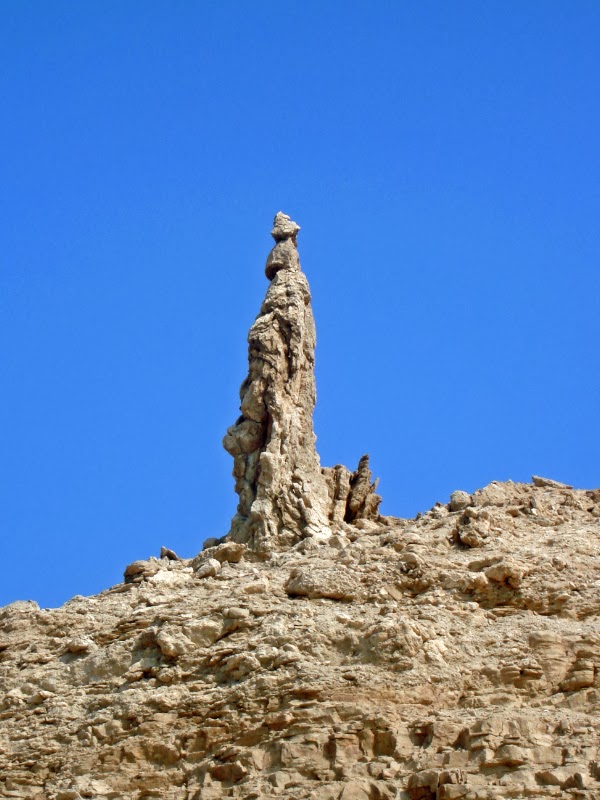
    v.26 However Lot's lingering seems to have taken deeper root in his wife and she is unable to grasp even the concept of eternal life and "looked back", presumably returning to the wicked world. This return is a step too far. The Lord can, for a short season, tolerate us taking a bit longer to grasp principles and get to the temple but returning to our wicked ways or our former life will not be tolerated. Consider this statement from the Lord,
    "No man having put his hand to the plough, and looking back, is fit for the kingdom of God" Luke 9:57-62
    And thus, Lot's wife perishes in the destruction. The Lord was quite specific in wanting us to remember this particular tragic choice. When speaking of the last days to the Pharisees he says, "Remember Lot's wife." (Luke 17:32). And in the latter-days he repeated the instruction (cf Doctrine and Covenants 133:14-15). Speaking of Lot's wife, Elder Neal A. Maxwell said,
    "Let us once and for all establish our residence in Zion and give up the summer cottage in Babylon" ("A Wonderful Flood of Light", BYU Devotional 26 March 1989)
    On a lighter note, when I hear this story I am always reminded of the story from Thomas S Monson who related an experience of one youth sunday school teacher,
    "The Sunday School teacher was describing how Lot's wife looked back and turned into a pillar of salt. Little Johnny was much interested. 'My mother looked back once while she was driving,' he explained, 'and she turned into a telephone pole!' " (Favorite Quotations from the Collection of Thomas S. Monson [Salt Lake City: Deseret Book Co., 1985], 23
    v.27-28 Meanwhile where is Abraham?  In the place where he stood before the Lord and where he can also see all the cities of the plain. It can be only one place. Abraham is in the mountain. Of course we would not expect anything less of Abraham. But it has more significance.
    v.29 This final summary of the story of Sodom and Lot has an interesting turn of phrase,
     "It came to pass that when God destroyed the cities of the plain, that God remembered Abraham and sent Lot out of the midst of the overthrow." 
    Why did God set his hand to rescuing Lot? He remembered Abraham. On the face of it that seems to be a bit illogical. Lot was saved because Abraham was righteous and asked for Lot to be saved? Surely we cant rely on someone else to get us to heaven and partake of eternal life? Well in a way we can (cf Alma 10:22-23 the prayers of the righteous) but in a way, ultimately, no we cant...unless it is the Saviour.

    And so the parable extends with Abraham is a type/symbol of both 1. our premortal Father in Heaven and 2. the Saviour, Jesus Christ, who was the only one to keep himself unspotted from this world.
    As our Father in Heaven, he leads Lot (us) and guides Lot (us). While Lot is with him he protects Lot (us) and blesses Lot (us). When it comes time to separate from him and come to this mortal fallen world (see Genesis 13:10  "even as the garden of the Lord" -the plains where Lot first pitches his tent are compared to the Garden of Eden which Adam and Eve leave to enter the dark and dreary world) We are instructed to live in the world but not be of it. We must work to be an influence on the world rather than allow the world to influence us.
    At some point holy messengers of God will give us a chance to set ourselves apart from the world, to be baptized and converted. It is not an easy process. We may lose loved ones on the way. We may take longer than is ideal but the ultimate goal is to gather to the temple and partake of the saving ordinances and covenants of the temple. And God in his mercy has provided a Saviour to plead on our behalf, to atone for our shortcomings as long as we never return to the wicked ways of the world. As if this was not enough consider the meaning of their names. Abraham is Father of a Multitude. Lot is a Covering. It would seem Lot's life was meant not only as a symbol of us but also as a reminder of the great covering sacrifice and Atonement that is necessary to our salvation.

    We are instructed to gather to the temple. The temples are our refuge from destruction and our sanctuary of peace. But the Lord is aware that we are imperfect and is aware how slow we are to listen and how often we linger in error's gloomy way. He is merciful. He has provided a Saviour who pleads for us and whose sacrifice covers our sins of commission and our sins of omission. But we must never look back. Remember Lot and Remember Lot's wife.