Showing posts with label temple. Show all posts

Saturday, September 27, 2014

Old Testament Lesson 37: Thou Hast Done Wonderful Things

Much of Isaiah is treasured for it's allusion to Christ and his life.
Today's study of Isaiah, instead of taking us through each chapter, focuses on several specific Messianic passages in Isaiah highlighting the wonderful things Christ will do and has done.

Isaiah 22:22 From one perspective Isaiah is discussing a man named El-iakim (which means "one whom God will raise"). In this verse it suggests he will take over the role of treasurer/finance minister from Shebna and have the keys to the city of David and will be a very powerful man. But on another level he is alluding to the Christ. Christ will take on the keys to the spiritual House of David, the priesthood keys and the keys of sealing. What else does Christ have the power to open and shut? (Hell, Spirit World) See also Rev 3:7-8,20 and John 14:6
Christ is the key to getting back to our Father in Heaven.

Isaiah 24:21-22 Having told the people that there is no escape for the wicked v.17-18. Isaiah repeats this notion but with one extra little detail. What is the other detail he adds. Who are the prisoners Isaiah refers to here? What hope can they cling to? Who will visit them?
v.23 What kind of light can confound the moons light and shame the suns light? As a prisoner left alone in darkness for an extended period of time, what would it be like to suddenly feel this light?


Isaiah 25:1-4; 32:1-2 How does Isaiah describe Christ in these passages:
  • a strength to the poor and needy in his distress
  • a refuge from the storm
  • a shadow from the heat
  • a hiding place from the wind
  • a covert from the tempest
  • as rivers of water in a dry place
  • shadow of a great rock in a dry land
What do these passages teach us about times when we are struggling?

Isaiah 25:6-8 "in this mountain" could refer to the geographical area Isaiah was preaching from but it also alludes to the Lord's kingdom and to the our modern temples. It is here where the chosen and elect will receive the benefits of salvation
a feast of fat things
a feast of wines on the lees
the veil of spiritual darkness and unbelief will be lifted
death will be overcome
all of our tears will be wiped away
rebuke of his people taken from off the earth
The last 3 items definitely have pertinence to the atonement and resurrection.

How can temple attendance help us receive these blessings? Who does it say will provide these blessings? Revelations 21:3-4 gives us more insight into what causes our tears that the Lord will wipe away. Notice he doesn't just stop us crying - he wipes the tears from our face. This is not just a public and infinite atonement - it is a personal and intimate atonement as well.

Isaiah 28:16 How is Christ our tried stone and our sure foundation? cf. Heleman 5:12, Doctrine and Covenants 50:44
Why will "he that believeth NOT make haste"? Compare to Isaiah 24:17-19.

Isaiah 29:4, 10-11,14,18 Bringing forth of the gospel in the latter-days through the restoration and the Book of Mormon is a marvelous work and a wonder that will heal the spiritually deaf and blind.
Isaiah 30:19-21 such beautiful comforting words of promise to the righteous and to the repentant. Is life meant to be easy?

From these few passages we see Jesus Christ as the key to returning to our Father in Heaven. It is  only through him. He is our light in the darkness, our hope, our protector and our saviour. He loves us. He is our tried and tested and sure foundation and he has restored his gospel in these latter days to bring to pass the purposes of the great plan. If we put our trust in his teachings, following his way and accepting his atonement in our lives we will not only feel the effects in our lives, we will see him.

Saturday, September 20, 2014

Old Testament Lesson 36: The Glory of Zion Will be a Defense


So who was Isaiah? We have few clues. The bible tells us that he was the prophet during the time of 4 Judean kings - Uzziah, Jotham, Ahaz and Hezekiah. He was a prophet for a span of close to 50 years, maybe more. And there is some suggestion that Hezekiah was his son-in-law and that Hezekiah's son Manasseh (Isaiah's grandson) killed Isaiah by putting him in a hollowed out tree trunk and having him sawn in half (cf Heb 11:37). So much for being able to enjoy your grandkids!

Isaiah's name means "Jehovah is salvation" and it is clear his name, ministry and life were meant to help point to Christ. Now before we start studying Isaiah it might be worth noting that 16 chapters of Isaiah are quoted in the Book of Mormon. For the next 5 lessons we will be studying Isaiah. The Saviour encouraged us to study Isaiah in 3 Nephi 23:1-3 ( I know some of us would prefer he had said the Book of Jarom or Omni) but interestingly although Nephi encourages a study of Isaiah also, he seems to recognize that people not of Isaiah's time and culture would struggle to understand his words. 2 Nephi 25:1-4. According to Nephi what is the key to understanding Isaiah?
The Great Isaiah Scroll of Qumran
Isaiah 1 we are told is a vision Isaiah had concerning Judah and Jerusalem.
What is the state of the people in v.2-4? rebellious, ignorant, sinful, evildoers, corrupted, gone away backward. Dumber than the dumbest animals - ox and ass.
What does that phrase "gone away backward" suggest?

How spiritually sick are the people? v.5-6 the whole head and the whole heart (leaders and the people) and notice what ails them - head is sick (unrighteous) hear is faint (weak and unrighteous), from head to toe it is ridden with wounds bruises and putrefying sores that have not been bound and closed or soothed with ointment. Based on that analogy what are the people sorely lacking? A good doctor? (cf Psalms 147:3). Who could heal them? And yet they hadn't even applied a band-aid yet. Why do people avoid repentance and healing?

What does he tell the people to do that are in this state? v.16-19 Repent, clean up.
v.18 "come now, and let us reason together" When? NOW. Don't delay.

v.29-30 alludes to the shrines set up and built with oak trees in gardens for idol worship
v.30 tow=tinder

Then he moves away from them and starts discussing the last days.
Isaiah 2:2-4 mountain of the Lord house to be established in the tops of the mountains.
It is interesting to note that when the Salt Lake valley was first settled, those that settled there wanted to call the region Deseret. However the US government in granting statehood insisted it be called Utah in common with their practice of naming states after the tribal people common to that area. Little did they realize they were helping fulfil this prophecy in Isaiah. Utah in the Ute language means "the top of the mountains".

Zion and Jerusalem to be the two centres of the Millenium. One the legal and judicial centre (constitutional) and one the spiritual centre (scriptural).
A world of peace and happiness is shown where there is no more war.

Why did Isaiah share this vision of the last days after telling people how sick they were? v.5  has the answer but try comparing to 2 Nephi 12:5 it's an invitation. You are wicked and suffering the calamities of your wickedness but there is a better way and one day it will be better. You can experience this if you walk in his light.

v.6-9 But currently you get your light and replenishment from psychics, eastern philosophies, marrying outside of the temple, your focus is on money, you have more cars and armies than you know what to do with, and you have sports idols, pop idols, movie idols and worship man-made things. Even your poor are proud! You give more credence to your own things than to the things of God. Google and Wikipedia are valued more than scripture. Which did you use more this week? We are far from the simple desire of the Lord's prayer - "give us this day our daily bread!" We chase riches and build armies in our vain efforts to self-preserve and forget the great Deliverer has promised us salvation and preservation if we just trust in Him.

What is the advice given if that is your state or condition in life - Hide! Crawl under a rock and hide! (cf Alma 12:14)

v.10. Why?
v.11-17 Because all the mighty and proud will be brought low. Cedars of Lebanon, Oaks of Bashan, Ships of Tarshish. All trees. Trees represent man. No matter how great you are, how powerful, how good-looking, how rich, He will bring you down!
v.10 and v.19 why will they hide? For fear - they will recognize he is greater than anything they put their trust in. Notice also it will be too bright for them..where do they go to hide? In dark places. Will their idols save them? No! v.20 in fact they are thrown to moles and bats. What do moles and bats have to with this? They also live in darkness and are blind!

And what is the lesson the Lord would have us learn from all of this? v.22  "Cease ye from man, whose breath is in his nostrils..." We are nothing, we live - carried along by a mere puff of air. Can we save ourselves? NO. Only he who is mighty to save can save mankind, through the great atonement.

Notice that Isaiah 2 has two great heights that can be reached in life - the tops of the mountains where you will find the Lord's house OR the loftiness of man (pride). Which are you closest to scaling?

Isaiah 3 is a continuation of the vision Isaiah had and here he is told in vision that the Lord will take away his support from the people. He will no longer feed them, taking away the wise and replacing them with immature leaders v.1-4

v.16-26 even the women are guilty of pride and being followers of fashion more than faithful followers of their God. They will be shamed and their families torn apart by war.

How great will be the desolation and destruction according to Isaiah 4?   7 women will ask 1 man to give them his name. Don't feed or clothe us just let us belong. (v.1) Only the righteous will be left in Jerusalem and Zion.
v.5-6 Every home (dwelling place), every congregation of his people (assembly) shall be protected by a pillar of fire at night, and by a cloud and smoke during the day. What else will be there - a tabernacle (temple). How is it described? As a shadow from the sun and heat, a cover from rain and storms and a place of refuge. Could we use a place to get away from the storms and the stresses of our life? Could we do with having a place of refuge and protection for us? Go to the temple!

Isaiah 5:1-7 The Lord now compares his people to a vineyard. How did he look after it? Built a fence (protection and defence), gathered out the stones (made life a rich place to grow for us) planted the choicest vine (the best, the chosen people were given for their roots Abr. 3:22-23), built a tower in the midst (a place of gathering and a sign of God's presence in our midst - the temple), made a winepress (gave us challenges to bring the best out of us). What was the result - sour grapes! What was the Lord's reaction - take away the protection and stop looking after it.
v.8-24 a expansion on who these sour grapes are.
wo unto them that call evil good, and good evil:
Spencer W. Kimball
Jesus Christ our Lord is under no obligation to save this world. The people have ignored him, disbelieved him, failed to follow him. They stand at his mercy which will be extended only if they repent. But to what extent have we repented? Another prophet said, "We call evil good, and good evil." Men have rationalized themselves into thinking that they are "not so bad." Are they fully ripe? Has the rot of age and flabbiness set in? Can they change? They see evil in their enemies, but none in themselves. Even in the true Church numerous of its people fail to attend their meetings, to tithe their incomes, to have their regular prayers, to keep all the commandments. We can transform, but will we? It seems that we would rather tax ourselves into slavery than to pay our tithes; rather build protections and walls than drop to our knees with our families in solemn prayers night and morning. (Conference Report, Oct. 1, 1961, p.31)
v.25 his hand is still stretched out against them - there is more destruction to come.
v.26 in the last days an ensign will be lifted and people will gather to it swiftly with the aid of young lions (missionaries).
LeGrand Richards
Since there were no such things as trains and airplanes in that day, Isaiah could hardly have mentioned them by name, but he seems to have described them in unmistakable words. How better could "their horses hoofs be counted like flint, and their wheel like a whirlwind" than in the modern train? How better could "Their roaring...be like a lion" than in the roar of the airplane? Trains and airplanes do not stop for night. Therefore, was not Isaiah justified in saying "none shall slumber nor sleep; neither shall the girdle of their loins be loosed, nor the latchet of their shoes be broken"? With this manner of transportation the Lord can really "hiss unto them from the end of the earth," that "they shall come with speed swiftly." (A Marvelous Work and a Wonder, p. 236)
Isaiah 6
Isaiah is called of God but feels unworthy of his call saying he has unclean lips and lives among people with unclean lips. How was Isaiah made worthy? v.6-7 Where did the coal come from? Why was it hot? What does the coal symbolize?

Once cleansed and purified Isaiah answered his call saying, "Here am, I send me" alluding to the Saviour's own mission call in the pre-existence.

Our first study of Isaiah has been a study full of symbols and imagery. But it is clear that the wicked are being called to repentance. The righteous are promised great blessings and all can still be saved through the cleansing power of the great atonement.
As we are cleansed, attend the temple and live the commandments we will find that the Lord's Glory will attend us and will protect us.

Saturday, August 9, 2014

Old Testament Lesson 30: "Come to the House of the Lord"

Re-store: 1. to bring back into existence or use; reestablish
Today's lesson focuses on two righteous leaders who had the courage and strength to restore the temple and scriptures to the people. 


2 Chronicles 29
v.1-2 Hezekiah righteous Jewish king
v.3 What did Hezekiah make a priority in his life and how do we know it was a priority?
"in the first year of his reign, in the first month" he opened the doors of the house of the Lord, and repaired them. How is our relationship with the Lord? Do we need to open the doors to Him? Do we need to repair our relationship with Him? Has our relationship been allowed to fall into a little disrepair?
 “Members of the Church today face great challenges, both temporal and spiritual. Have we, on occasion, also ‘turned away [our] faces from the habitation of the Lord . . . [and] shut up the doors . . . and put out the lamps.’ Are we also ‘negligent’? Often so many pressures demand our time and attention. However, considering the times and the forces arrayed against our families, should we not follow Hezekiah's example and ‘sanctify the house of the Lord . . . in the first year of the first month?’ (Emphasis added.)” (S. Michael Wilcox, House of Glory: Finding Personal Meaning in the Temple [Salt Lake City: Deseret Book Co., 1995], 62)

v.16 How did Hezekiah mend the people's relationship with the Lord? Cleansed the inner part, brought out all uncleanness from within and it was put into the brook Kidron. Why is that final detail in there? Because it shows a complete and utter abandonment of the uncleanliness. The brook Kidron once crossed was considered to be where you have at that point left Jerusalem. Essentially if you got this far, you were not planning on turning around. Likewise, if you bring your unclean things here, you are not planning on bringing them back with you. Thus taking all that was unclean symbolized the commitment to a complete and full and permanent cleansing.
v.17 We are told it took 8 days to cleanse the temple from within right up to the front porch. The people then took another 8 days of cleansing. What else might they have needed to cleanse other than the temple? Likewise, other than personal cleansing within, what else may we need to cleanse in and around our daily lives? In Hebrew culture, the number 8 symbolizes "new beginnings". That it took them two 8 day periods to fully cleanse again emphasizes their commitment to starting afresh with the Lord. What latter-day new beginning also has the number 8 associated with it? Baptism.
v.20 In our previous studies we have seen how the righteous are always noted in scripture for rising early. Hezekiah is no exception.
v.21-24 Part of the cleansing in former days is the sanctification through blood sacrifice. This practice was set up to foreshadow the ultimate and final, the last and ever-lasting, blood sacrifice, the Atonement of Jesus Christ. Goats were often used as symbolic sacrifices for our sins. Thus the term "scapegoat" originated wherein someone else took the punishment for someone else.
v.24 "for all Israel" Why did Hezekiah make offerings on behalf of the Kingdom of Israel as well as his own kingdom of Judah? Was it just symbolic or did it have some practical use? Is this similar to our vicarious baptisms for the dead?
v.36 "for the thing was done suddenly" How quickly can we change if we truly want to? What delays personal cleansing?

2 Chronicles 30
Hezekiah invites all of Israel and Judah to cleanse themselves and come to the temple. Some do accept but many reject the invitation with mocking and scorn. Those that do accept are not fully temple worthy but through the righteous desires of their hearts, the prayers of Hezekiah and the sanctification of the offerings, they earn the mercy and healing of the Lord.

What was the result of Hezekiah's determination and priorities? The temple was restored.  Many people repented and were healed. Their prayers were heard. 

Spencer J Condie said,
"From King Hezekiah, as from King Benjamin (see Mosiah 2–5), we can learn a very positive lesson on leadership: circumstances do not always need to remain the same. Leaders can make a difference! Faith in the Lord and high expectations can bring about a mighty change of heart among an entire people." (“Some Scriptural Lessons on Leadership,” Ensign, May 1990, 27–28)

Sadly the great majority of the northern kingdom who mocked the idea of temple attendance and ordinances providing them protection, were (just a short three years later) attacked by Assyria and within three years after that initial attack they were carried away captive. This is the beginning of the lost ten tribes. 2 Kings 18:9-12. Interestingly enough in 1841 Joseph Smith was told to issue a similar invitation to all the world and the saints in Doctrine and Covenants 124:2-4, 10-11, 27-28. How did that turn out?

2 Chronicles 32
Sennacherib, King of Assyrria decides he wants to invade and sack Jerusalem.
v.3-8 What does Hezekiah do? cuts off anything that might give life to this invader of their sanctified lives. How can we cut off the oxygen or the water supply that feeds sin as it tries to invade our freshly sanctified lives? Notice Hezekiah does not rest on his sanctified laurels, he strengthens himself more. He rebuilds the wall higher and he builds a second wall of defence. He also prepares for a fight, adding more weapons. He organizes his people, appointing leaders and he inspires them, reminding them of who they ultimately look to for protection. How might we learn from this in our own homes and families?
Who are the servants of the Lord?
What is the heritage of the servants of the Lord? See 3 Nephi 22:17

v.9-20 Did Sennacherib attack them in open battle? No. He could not the defences were too high. So how did he attack them? He himself didn't directly attack them. He sent his servants among them to weaken their faith. He wrote letters to the people to weaken their resolve and even spoke to those on the walls in their own language to frighten them into giving in.
v.21 How did Hezekiah respond? Prayer. What was the result? How powerful can prayer be in our lives? see also 2 Kings 19:35

2 Chronicles 34
Hezekiah eventually dies, first his son Manasseh and then his grandson, Amon rule unrighteously. But then his great-grandson Josiah begins to reign at the age of 8 years old. Notice the symbolism of a new beginning. Josiah reigns in righteousness refusing to be turned.
v.3 after 8 years of ruling he starts to find his voice and seeks the God of David.In the twelfth year, being 20 years old Josiah begins to purge the land once more of false gods and the high places and altars that housed them
In his 26th year he takes the tithes and offerings that have been collected and uses it to rebuild the temple of Jerusalem. As they gathered the tithes and offerings of the temple what else did they find?
v.14 the book of the law of the Lord, as given by Moses.
It condemns the people to death for forsaking the Lord. When Josiah consults the prophetess Huldah, she confirms that future generations will die as a result but that he will be preserved because of his faithfulness and his humility. Josiah might be tempted to retreat within his self-preserved bubble but instead what does he do?

George Albert Smith remarked,
I am not concerned whether or not you have the books of the great libraries of the world in your home, provided you do have these books [the scriptures]. Think of the millions of volumes that there are in our own Congressional Library at Washington, in the British Library, and in the libraries of other countries, millions of volumes—and yet all that God has revealed and published to the children of men that is necessary to prepare them for a place in the celestial kingdom is contained within the covers of these sacred books. How many of us know what they contain? I frequently go into homes where I see all the latest magazines. I find the books that are advertised as best-sellers on the bookshelves. If you were to throw them all away and retain only these sacred scriptures, you wouldn't lose what the Lord has caused to be written and made available for us all to enjoy. So, brethren and sisters, among our other blessings let us not forget that the Lord has made it possible for us to have, enjoy, and understand the scriptures and to have his word that has been given down through the ages for the salvation of his children. (The Teachings of George Albert Smith, edited by Robert McIntosh and Susan McIntosh [Salt Lake City: Bookcraft, 1996], 52)

v.29-33 Josiah commits the people to live the Law of the Lord. They do all the days of his life.

Throughout this lesson, the temple's complete restoration to full usage and focus on the scriptures is hailed as the central component of people becoming sanctified and being able to draw upon the powers of heaven. Are those powers available to us today? How might we more fully restore the temple in our lives?

President Howard W. Hunter encouraged:
“Let us be a temple-attending people. Attend the temple as frequently as personal circumstances allow. Keep a picture of a temple in your home that your children may see it. Teach them about the purposes of the house of the Lord. Have them plan from their earliest years to go there and to remain worthy of that blessing.
“If proximity to a temple does not allow frequent attendance, gather in the history of your family and prepare the names for the sacred ordinances performed only in the temple. This family research is essential to the work of the temples, and blessings surely will come to those who do that work” (in Conference Report, Oct. 1994, 8; or Ensign, Nov. 1994, 8).

When personal circumstances or proximity do not allow us to attend the temple regularly, what other way, according to President Hunter, can we show the Lord that our hearts are in the right place?

"Let us be a temple-attending and a temple-loving people. Let us hasten to the temple as frequently as time and means and personal circumstances allow. Let us go not only for our kindred dead, but let us also go for the personal blessing of temple worship, for the sanctity and safety which is provided within those hallowed and consecrated walls. The temple is a place of beauty, it is a place of revelation, it is a place of peace. It is the house of the Lord. It is holy unto the Lord. It should be holy unto us." (The Teachings of Howard W. Hunter, edited by Clyde J. Williams [Salt Lake City: Bookcraft, 1997], 239)

 Brigham Young once said,
If every one of the Latter day Saints lived up to their privileges, they would not fear the world, and all that they can no, any more than they fear that the cranes, that fly croaking three quarters of a mile above them, will drop their eggs upon them to dash their brains out. You might as well fear that event, as to fear all the forces of hell, if the people were sanctified before the Lord, and would do His will every day.
 
Are these ideas strange to you? Read and learn how the Lord protected the children of Israel in former days, even during their wickedness, and rebellion against Him.
 
Whenever a good man would say, "Cease your wickedness, turn from your idols, and seek to the Lord," and they hearkened to his counsel, then the Lord would fight their battles, and kill their enemies by scores and hundreds of thousands. And on one occasion the angel of the Lord slew one hundred and eighty-five thousand of those who came against His people to destroy them, "and when they arose early in the morning, behold, they were all dead corpses." So reads the Bible. The Lord fought their battles.
 
Again, Elisha's servant saw that there was more for them than all who were against them; he saw that the sides of the mountains were covered with "chariots of fire."
 
When the Lord commands those invisible beings, shall I say, those who have had their resurrection? yes, millions and millions more than the inhabitants of this earth, they can fight your battles.
 
Now, since one angel could fight their battles in former times, and overcome the enemies of the people of God, whom shall we fear? Shall we fear those who can kill the body, and then have no more that they can do? No, but we will fear Him who is able not only to destroy the body, but has power to cast both soul and body into hell fire. (Journal of Discourses, 26 vols. [London: Latter-day Saints' Book Depot, 1854-1886], 2: 255 - 256)

Saturday, July 12, 2014

Old Testament Lesson 26: King Solomon: Man of Wisdom, Man of Foolishness

We are studying Solomon today. Much of the reading is taken from 1 Kings but a comparative reading can also be found in 1 Chronicles 1-9.
 
If you were to be granted one wish. Just one. Anything you want. What would it be?
Now if a 20 year old had just one wish what do you think they would ask for?

This is the situation a young Solomon found himself in after he became King. We don't know his exact age but most scholars believe that he became King somewhere between his early teenage years to early twenties. In 1 Kings 3:5 we are told:
"In Gibeon the Lord appeared to Solomon in a dream by night: and God said, Ask what I shall give thee."
In a small survey a few years ago, over 70% of teenagers when asked what they would want if they had one wish, said they wanted money, wealth or material possessions. What did Solomon ask for?  Read 1 Kings 3:6-9 "An understanding heart."
Somewhat overwhelmed by all the people he was now responsible for, he sought this gift not for adoration or recognition but so that he may discern between good and bad to judge the people righteously. We see this humility time and again from servants of the Lord, this recognition of their own inadequacies and their need to rely on the Lord's gifts.

What do you think put Solomon in a position to have been offered such a wish? Was it because he was a king? Was it because he found a magic lamp with a genie inside? Read 1 Kings 3:3-4
The reason Solomon was granted this great wish was because of three things:
He loved God
He obeyed the laws of the land
He made sacrifice to God in the most high place

Do you think having this wisdom of God would be useful in work, in families and in church? How might we be able to get this gift of wisdom and an understanding heart?

I suspect the Lord is willing to grant us our righteous desires if we similarly live righteously, love God and worthily attend his temple with the sacrifice of a broken heart and contrite spirit. Notice after granting Solomon his righteous desire he also grants Solomon riches and honour and if he remains righteous, long life. (1 Kings 3:12-14)

On a side note you may have noticed the description of Gibeon in those verses and wondered why it claims the title of "the great high place". As we know there was no temple in those days and so altars were built upon the mountains which were considered holy places themselves. David built a tabernacle in Jerusalem to house the Ark of the Covenant but the original Tabernacle of Moses that had been built in wilderness was, in the time of Solomon, set up at Gibeon. This tabernacle was held with great esteem for obvious reasons and thus was considered "the great high place". It was essentially the equivalent of our modern day Salt Lake City Temple. It was not the only "high place" whereby the people of Israel could go and make offerings but it was held in great esteem among all the high places.

The clear example of Solomon's wisdom is now infamous. Two prostitutes claim a single living child is theirs. Solomon carefully watching the body language and reaction of the two prostitutes deduces the true mother. Solomon is rightly considered wise but I wonder if he is remembered as wise for the wrong reasons. Not to suggest solving this very emotional and tough personal drama was easy but I suspect we may miss the point. Solomon's wisdom was not shown through the decision he made but rather through the fact that he even heard the case. Here is Solomon. He is the King. He has just spoken with God. He has just offered sacrifices at the two most holy places in the Kingdom - the tabernacle of Moses at Gibeon and the tabernacle of David in Jerusalem. Why would Solomon then lower himself to discuss a private squabble between two unworthy and unclean prostitutes. Therein lies the true wisdom of Solomon (and of God). True wisdom recognizes that we are all equal in the sight of God. We all are his children. Just because our choices are righteous and other's choices are unrighteous does not mean we treat others differently. Solomon recognized this and in choosing to hear this case of the two prostitutes he sent a clear message to his people that he was concerned for all of his people and that he would be fair in his judgements. Likewise God too loves us all, righteous or unrighteous. Even the lowest of us all will have their chance to plead their case before God. And we can feel sure that we will be judged righteously and fairly.

Solomon decides to build a permanent temple to the Lord. What motivated him to do this? Read 1 Kings 5:3-5
Solomon had heard of the prophecy and decided to fulfill it. Sometimes I wonder if we wait a little too much for prophecy to be fulfilled by God or by others. How might we each be able to fulfill prophecy today?
As you ponder this question within the context of your personal life, patriarchal blessings, your family and the church in general you may wish to read this talk by Elder Pearson of the Pacific Area Presidency from 2013. But one of the things he says is:
"Those willing to exercise faith in the Lord Jesus Christ and to follow His latter-day prophets will not be content to merely watch these things happen. Motivated by our love for the Saviour and all of the Father’s children, each one of us can all help to make things happen."
How many others helped fulfill the prophecy of the temple being built in Jerusalem? 
Read 1 Kings 5:13, 15-16, 18
Clearly many people were needed to build the temple in Jerusalem. Likewise, here today we are all enlisted in this great work. We are all needed to help fulfill the prophecies of the last days.

There are a number of measurements and details found in 1 Kings 6 regarding the temple building. On another day they all have lessons we can learn from them, but the verse that touches me most is verse 7 where we read:
"And the house, when it was in building, was built of stone made ready before it was brought thither: so that there was neither hammer nor axe nor any tool of iron heard in the house, while it was in building."
What does this tell us about how Solomon and the people felt about the temple? Can you imagine the extra sacrifice and effort that took? Some may have considered this an unnecessary inconvenience when the building had not yet been constructed and dedicated. Do we have similar situations today where worldly logic defies spiritual logic? It puts me in mind of the great sacrifice Hannah made. Before Samuel was even born into his mortal temple, he had been dedicated to the Lord. These acts are not within the basic gospel requirements. Such acts stand above the basic requirements and mark out those among us who have the greater faith and desire. They are to be honoured and held up as higher examples for us all to aspire to, like stepping stones of faith in our upward journey to become like Him and as Him.


The temple took 7 years to build. Upon completion of the temple they offered many sacrifices and held a great feast. The dedicatory prayer was offered by Solomon. The passage I would like to focus on is 1 Kings 8:44-53
This is another passage of scripture that I find so very touching and indicative of the Lord's love and mercy for us all. Having completed this great temple and dedicated it, the people of Israel will be able to participate in and do the great work within the temple. This requires taking on covenants that come with blessings and warnings. Solomon curiously yet prophetically indicates that wars lie ahead and maybe even being carried away captive into foreign lands ("for there is no man that sinneth not"). And in so doing calls upon the Lord to forgive those that sin
"...if they bethink themselves...and repent, and make supplication unto thee...And so return unto thee with all of their heart, and with all of their soul, and pray unto thee toward their land and the house which I have built for thy name: Then hear thou their prayer and their supplication and maintain their cause and forgive thy people that have sinned against thee and all their transgressions wherein they have transgressed against thee"
There isn't a soul among us who has not made a wrong turn, a bad decision or a foolish choice. But there is power, healing power to be found within the covenants of the temple when coupled with true repentance.
Solomon's dedicatory prayer also indicates that the temple itself would influence even those who were not of Israel 1 Kings 8:41-43. How might this passage apply to the temples and the Saints and the non members of the Latter Days? It puts me in mind of the words to our primary hymn:
"I love to see the temple. I'm going there someday

To feel the Holy Spirit, To listen and to pray.
For the temple is a house of God, A place of love and beauty." "I Love to See the Temple"
 President Ezra Taft Benson similarly said,
“In the peace of these lovely temples, sometimes we find solutions to the serious problems of life. Under the influence of the Spirit, sometimes pure knowledge flows to us there. Temples are places of personal revelation. When I have been weighed down by a problem or a difficulty, I have gone to the House of the Lord with a prayer in my heart for answers. These answers have come in clear and unmistakable ways” (“What I Hope You Will Teach Your Children about the Temple,” Ensign, Aug. 1985, 8).
I have a personal testimony of the peace that can be found within the temple and of the ability of the Spirit's whisperings within to wash away the woes and worries of the world outside. I invite you all to seek that peace. If you are not a member, go visit the grounds of a temple. Sit and contemplate your life and your purpose and your desires in that setting with sincerity and you will find answers.
To find the nearest temple to you, click on this link: Current LDS Temples in the World

Despite Solomon being granted God's wisdom, choice is still a personal matter and later in his years Solomon made some foolish choices. Firstly he took wives that lead him away from his priorities and beliefs. Then he actively built altars and high places for other gods, notably Ashtoreth, Milcom and Chemosh, the gods of the Zidonians, Ammonites and Moabites. How does someone so wise make such foolish decisions? What can we learn from Solomon's sad example in his later years?
Notice the progression into foolishness from wisdom:
  • He is imbued with God's wisdom
  • He is praised by all including foreign dignitaries such as the Queen of Sheba
  • He is drawn to flattering words and loved many strange women.
  • These wives turned away his heart
  • They turned away his heart to other gods
  • His heart was not perfect
  • He did evil in the sight of the Lord.
We will learn in the oncoming weeks that as a result of Solomon's foolishness, the Lord allows the kingdom of Israel to be split into two. The Northern Kingdom of Israel and the Southern Kingdom of Judah. Within the span of just their first three kings, Israel has learned that not following the wisdom and counsel of the Lord and insisting on kings rather than God to lead them has left them divided and conquerable. That wisdom is only found through righteous choices. Solomon did not become righteous because he was wise. He became wise because he was righteous. Once he gave up righteousness, he lost his wisdom also. Some 300 years later Solomon's temple was destroyed. One family fleeing that oncoming destruction had a son called Jacob who wisely noted, "To be learned is good, if they hearken unto the counsels of God". (2 Nephi 9:29)


Saturday, February 22, 2014

Old Testament Lesson 8: Living Righteously in a Wicked World

Abraham's Chronology and Travels:
Abraham moved around a lot and led a pretty nomadic lifestyle. To bring us up to date with today's lesson I have compiled a brief chronology of Abraham's travels. I do believe there is much to be learned from a deeper study of the geography of these stories but we will not have time to go into too much detail this week. Nevertheless, this short chronology should help us to get a better idea of where Abraham has been and what he has been doing, up until the point when we reconnect with him in this week's lesson.

1. Born in Ur in land of Chaldeans
  • There is a famine and idolatry throughout the land
  • Abraham's brother Haran dies
  • Abraham marries Sarai
2. Moves to land they called Haran after his brother, who died in Ur (to escape idolatry and seek blessings) Abr. 1:1-2; 2:3
  • Abraham's wife Sarai, his nephew Lot (Haran's son) and his wife, and Abraham's father follow him.
  • Abraham's father returns to his idol worship and eventually dies in Haran, 205 yrs old.
3. 62/75 yrs old - moves to the land of Canaan (promised to be "an everlasting possession" to his seed). There appears to be some discrepancy between Genesis and the Book of Abraham account as to Abraham's age when he left Haran.
  • Takes his wife Sarai, Lot and his family, and the converts from Haran
  • Lived in tents, built an altar in Jershon to pray for his family in the famine.
4. Moved to Shechem (Sechem) in the plains of Moreh. Built an altar unto the Lord. "Unto thy seed will I give this land".
Shechem becomes a very significant place to the children of Israel. It is here that Jacob also returns to settle and digs a well. Here Joseph goes to find his brothers and just beyond here he is sold into slavery. Is it any wonder that his request before he dies in Egypt many years later is to be buried at Shechem. It is here too that Joshua gathers the returning tribes and recommits them to the covenants of the Lord in their promised land. The same promises and promised land as Abraham received in Shechem generations before. And here that Joshua buries the bones of the prophet Joseph.
5. Moved to mountain between Bethel (House of God) and Hai (Heap of Ruins). Built another altar unto the Lord.
  • Continues south. Famine continues.
6. Moves to Egypt (to avoid the famine)
  • Teaches Egyptians using astronomy and gospel teachings 
  • Pharoah tries to take Sarai to wife understanding her to only be Abraham's sister
  • Pharoah gives Sarai back and gives Abraham more wealth and asks him to leave Egypt.
7. Moves back to land of Canaan, between Bethel and Hai
  • Made offerings at the altar and called upon the Lord again.
  • Returned with more wealth and more people including an Egyptian handmaiden called Hagar
  • Lot and his family still with Abraham
At this point Abraham is no older than 86 yrs old.

Dealing with Strife  
Genesis 13
Firstly, let's understand the relationship between Lot and Abraham. Abraham is Lot's uncle (Lot's father was Abraham's brother Haran, who died in Ur). Lot has followed with Abraham from Ur to Haran onto Canaan and down into Egypt and back again into Canaan. By the time Lot is introduced to the story, he is already married. They have probably journeyed and lived together at least 20 years. They are close and Lot has greatly benefited from being in Abraham's presence.
 
v.2 and v.5 Abraham is rich in cattle, silver and gold. Lot has flocks and herds and tents. Both have done well for themselves although you feel that Lot's wealth is likely somewhat as a result of his association with Abraham.
v.6-7 What was the initial problem? What then highlighted the problem? What could potentially make this problem very serious?
The initial problem was that they had been blessed with so much that the area they were living could no longer support all of their herds and all of their people. This was highlighted when the herdmen of Abraham and the herdmen of Lot had a "strife" between them. This might not seem like a big deal initially but the seriousness is found in the final sentence of verse 7: "and the Canaanite and the Perizzite dwelled then in the land". If they do not find a solution to this internal strife, it will invite strife from other groups who occupied the land and who would desire their cattle and herds and land. It was very important that this issue is solved quickly before they paint a big target on their backs.
v.8-12 Who seems to be the proactive party in trying to resolve this? What does this suggest about Abraham? What is Abraham's solution? As patriarch of the family (according to custom and tradition), and with the promises of the Lord established with him, Abraham has every right to pick where he chooses to settle, first. Instead he offers the first pick to Lot. What can we learn from Abraham's approach?  
"It is Abraham who took the initiative and said unto Lot, 'Let there be no strife, I pray thee, between me and thee,...if thou wilt take the left hand, then I will go to the right; or if thou depart to the right hand, then I will go to the left.' (Genesis 13:7-9.) The complete, genuine willingness of Abraham to adjust to whatever Lot's decision was is the mark of a generosity of spirit of that remarkable patriarch." Neal A. Maxwell (That My Family Should Partake, pp92-93)
Lot chose what he viewed to be the most watered and most fertile land. He used his eyes as far as they could physically see. What did Lot miss? see v.12-13 
Meanwhile Abraham, who appears to have got the short end of the stick if you are looking at things with physical eyes, has his spiritual eyes opened. see v.14-18 
Notice both lifted up their eyes to see but one had the guidance of the Lord and the other didn't. Why do you think Lot, who was a righteous man, did not have spiritual sight in this instance? What sins of omission deprive us of spiritual sight today?

Redemption of the righteous
Genesis 14:1-16
So Lot has pitched his tent towards Sodom (compare this to those that pitched their tents during King Benjamin's temple discourse in Mosiah 2:6), which seems to suggest that he had dealings in some part with the people of the city, maybe for trade. Certainly he looked toward the city with some positivity, maybe as some benefit to him. But this inability to fully separate from the wickedness of the world ends up impacting Lot and his family in devastating fashion.
The region had 5 cities: Sodom, Gomorrah, Admah, Bela (later called Zoar), and Zeboiim. Each city had its own king. They paid tribute to 4 other kings. But after 13 years they stopped paying this tribute and the 4 kings came to do battle with the 5 kings (including the King of Sodom). The 4 kings routed the 5 kings and as was the custom the victorious kings took their reward:Sodom was pillaged and looted and some of the locals were carried away captive. (see v.11-12)
Notice the difference between Genesis 13:12 and Genesis 14:12. For whatever logical or logistical reason, Lot is no longer on the edges of wickedness, he is living in it. How do you think this impacts him, his family, and especially his children?
v.14 Abraham could have done nothing and said it was Lot's own fault. Considering he is going to have to go up against 4 powerful kings and could be about to make some powerful enemies, you wouldn't blame him for not helping Lot. But he does help. Abraham's swift action is likely what saved his nephew.
Now consider this little bit of information "he armed his trained servants, born in his own house". The bible is full of little comments like that, they seem insignificant at first. But I am of the school of thought that believes scripture is the word of God (as far as it has been correctly translated) and each detail is in there for a reason. So when I read that Abraham armed his trained servants and that they were born in his own house it makes me ask why the Lord wanted me to know that detail. I'm not sure the answer in this instance but wonder if it might be that we should learn the great power and strength that can come from being untouched by the world. Lot, who chose to be part of that world is carried away captive as a result of his association with Sodom. But Abraham's trained servants who are unpolluted, untouched by anything other than what Abraham has taught them are strong enough not only to resist but defeat the pillaging kings and rescue Lot. They were brought up in righteousness, in Abraham's house from birth. Lot obviously found it difficult to live in the world and not be touched by it. Yet Abraham managed it. As our world becomes increasingly more wicked how do we live in the world without being touched by it as Lot was? Can we? Can we live as Abraham lived?
v.16 what is the result of Abraham's intervention? Lot and his family and all his goods are restored. This is full restoration of blessings
If we liken Abraham to Christ and Lot to us, what basic truth does this story teach us? 

The Lesson of the Two Kings
Genesis 14:17-24
After this rescue Abraham is approached by two kings. What happens next tells you everything you need to know about Abraham and the source of his confidence and strength.
Compare Genesis 14:17, 21-24 with Genesis 14:18-20.
After a victorious battle Abraham should be well within his rights to take the victor's spoils. Yet rather than taking spoils he gives of his own wealth to the King of Salem, Melchizedek. What is going on here? Consider these questions:
Why is Abraham not taking any of the victors spoils?
If he is not taking any, why does he insist that those local tribe leaders who helped him have their spoils?
In giving tithes what do you think Abraham is acknowledging?
It seems to me that Abraham was not interested in wealth, he had lots of it but he obviously was not interested in gathering it. He did not have a love for it.
v. 22-23  Accepting the spoils of war (which were likely originally stolen from Sodom and the other cities looted) would put Abraham in debt to the King of Sodom, who represents the wicked world. Abraham makes it clear that he does not want any association with the King of Sodom or therefore symbolically, the wickedness of the world or the leader of this wicked world, Satan.
However, Abraham does not force his beliefs on others and thus insists that the other tribal leaders get their spoils.
In giving his tithes to Melchizedek, Abraham is, in essence, offering thanks to the Lord. He is showing recognition that this victory was not his but the Lord's. Melchizedek (literally translated "king of righteousness") was the king of Salem (later called Jerusalem) and he was the officiating great high priest of the day and therefore both the representative and symbol of Christ. Thus the tithes figuratively become the spoils of victory and Abraham gives the spoils to the truly victorious King of Kings via Melchizedek.

The Parable of Sodom and Lot
Genesis 19:1-29
Many people suggest that much of the bible stories in the Old Testament are more parabolic than biographical. Job is a prime example of an Old Testament character that many say did not really live but whose story serves merely as a parable. I am more of the opinion that most of these characters did live AND that their lives served as parables to us. One such story is the story of the city of Sodom and Lot, it's most famous citizen. As you study it you will find a story rich in drama but also in context and meaning to us today. For that reason I have titled this section of scripture study, the Parable of Sodom and Lot.

v.1-2 When Lot first made his move away from Abraham he "pitched his tent toward Sodom". When we last saw him we are told that he "dwelt in Sodom" and now we are told he sat "in the gate of Sodom".  In ancient times to suggest someone "sat in the gate of the city" was akin to indicating that they held a civic position of authority. Lot has become firmly entrenched in Sodom and yet Peter tells us that Lot was a righteous man (cf 2 Peter 2:7-8). Peter's commentary suggests that Lot had to listen to unlawful deeds every day and they "vexed his righteous soul". This would lend credence to the idea that Lot sat in the gate of the city as a judge of Sodom. The obvious contrast in Lot is that he himself is righteous and yet he seems drawn to the wicked city. What do you think attracted Lot to Sodom?

Of course for all Lot's tolerance of this wicked city, things were about to change very quickly. Three angelic visitors are sent to rescue Lot from Sodom that night. Based on the Joseph Smith Translation of Genesis 18 and 19 we learn that these three angels were holy men (see footnote a. Genesis 18:22; 19:1,12).
Another sign of Lot's righteousness is that he recognizes these holy messengers, he warns them of the city's wickedness and hurries them into the protection of his home where he cleans and feeds them and protects them from a lusting and angry mob. When it is obvious to the Lord's messengers that Lot is truly converted, they step forward and take over, striking the mob with blindness (as they always could have) and start the process of evacuating Lot and his family from the city that is about to be destroyed because of its wickedness. What sins was Sodom guilty of? (cf Ezekiel 16:49-50) How do these sins compare to the sins of the world today?
v.12 is a great opportunity for Lot to save anyone and everyone he can. I have often thought of this as one of the great missionary scriptures. "For it becometh every man that hath been warned to warn his neighbour". Lot is being asked for referrals! Bring them out of this place! Gather them to Zion!
v.14 like the good member missionary Lot is, he goes to his children and their husbands. But they dont take him seriously. A likely modern version of their response is "Dad, its the middle of the night. Are you mad? Quit getting so excitable - take your pills and just go back to bed. Nothing's going to happen to the city. Haha! Goodnight Dad!" (cf 1Nephi 2:11-13) This was a common reaction in the old world and in the latter days)
Why do you think they did not listen to Lot or take him seriously in spiritual matters?
v.15 it is now the next morning and no one has evacuated. The messengers tell Lot to hurry up and take his wife and two daughters still at home, and leave the city immediately. Why? "lest thou be consumed in the iniquity of the city".
v.16 why did Lot "linger"? We know he is righteous. We know he believes the warnings. Why does he linger?  How much effort have we made in warning our families and friends, our loved ones? When the time comes will we feel responsible for not having warned them enough? The holy messengers have to drag Lot and his wife and two daughters away; "the Lord being merciful unto him". They are therefore separated from the wicked, being left outside the city. Notice in contrast Abraham had always kept himself separate from the wicked.
v.17 having separated Lot and his family the holy messengers give them four final instructions before leaving them.
  1. Escape for thy life
  2. Look not behind thee
  3. Neither stay thou in all the plain
  4. Escape to the mountain
Now I got so excited when I read this, I actually stopped my daughter from watching TV so that I could explain it to her. I love the scriptures they are so full, if you just search them! So consider this:

Sodom represents the world and Lot represents us.
We live in a world that is wicked. And we are told that at some point there will be a separation - the wheat from the tares; the righteous from the wicked. Before that happens though we are told that we must warn others (see v.12).
Some family or friends will accept the warnings, others wont. Some may even think you are a little crazy. (see v.14).
Whether or not they join you, you must separate yourself from the wickedness of the world, even if that means you lose loved ones in your life. (see v.15). Some of us may linger a bit in leaving behind those people and those things we love. Some may find it harder than others to do this. But the Lord wants us to know the time is at hand. Moreover the Lord, in his mercy will grab the righteous by the hand and drag us away if he has to. (see v. 16)
At some point we all need to make this decision to separate from the world (it may happen at our baptism, it may happen later in life) but when we do act on this decision and have separated ourselves from the wickedness of the world the Lord gives us 4 further instructions:
  1. Eternal life is at stake! ("Escape for thy life")
  2. Do not long for or go back to the ways of the world ("Look not behind thee")
  3. Do not even associate with it or get close to it ("Neither stay thou in all the plain")
  4. Go to the temple and partake of the saving ordinances and covenants ("escape to the mountain lest thou be consumed")
So the message this week to all that are "righteous" (have accepted the Lord and his gospel in their lives) is to remember that your are fighting for your eternal life. If you go back to your former ways or the ways of the world, if you even walk on the edge, sit on the fence, or peer over the city walls you will be consumed and destroyed with the wicked. The only way to guarantee survival is to escape from it all and become worthy of and partake in the saving ordinances and covenants of the temple. Therein lies eternal life.

Now read on:
v.18-20 What? Lot didn't want to go to the mountain? He didn't go? He delayed it again?
v.21-22 The Lord in his patience and mercy gives Lot time and allows him to stop instead in a smaller city that he promises not to destroy immediately. Lot understood he needed to escape. Lot got out of the wicked world but he is still not prepared to go to the temple. Instead he asks for more time. The Lord is merciful and gives Lot more time.
v.26 However Lot's lingering seems to have taken deeper root in his wife and she is unable to grasp even the concept of eternal life and "looked back", presumably returning to the wicked world. This return is a step too far. The Lord can, for a short season, tolerate us taking a bit longer to grasp principles and get to the temple but returning to our wicked ways or our former life will not be tolerated. Consider this statement from the Lord,
"No man having put his hand to the plough, and looking back, is fit for the kingdom of God" Luke 9:57-62
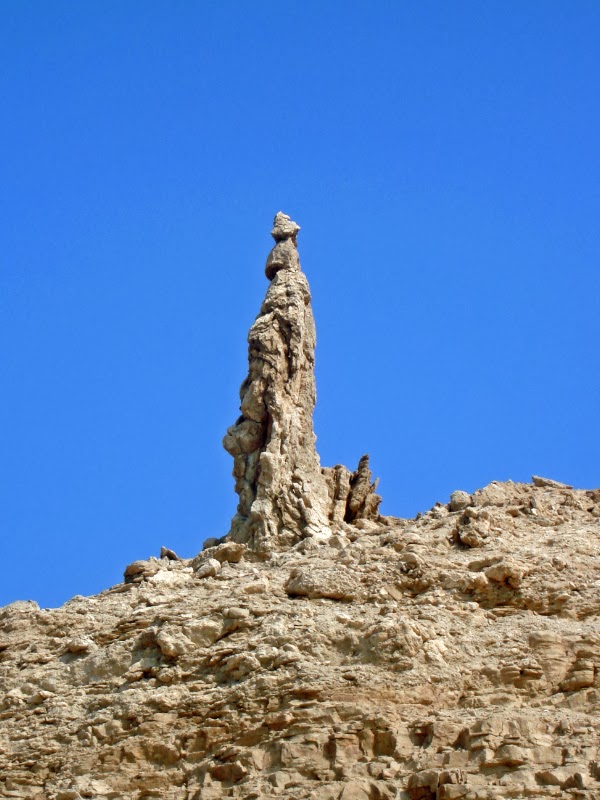
And thus, Lot's wife perishes in the destruction. The Lord was quite specific in wanting us to remember this particular tragic choice. When speaking of the last days to the Pharisees he says, "Remember Lot's wife." (Luke 17:32). And in the latter-days he repeated the instruction (cf Doctrine and Covenants 133:14-15). Speaking of Lot's wife, Elder Neal A. Maxwell said,
"Let us once and for all establish our residence in Zion and give up the summer cottage in Babylon" ("A Wonderful Flood of Light", BYU Devotional 26 March 1989)
On a lighter note, when I hear this story I am always reminded of the story from Thomas S Monson who related an experience of one youth sunday school teacher,
"The Sunday School teacher was describing how Lot's wife looked back and turned into a pillar of salt. Little Johnny was much interested. 'My mother looked back once while she was driving,' he explained, 'and she turned into a telephone pole!' " (Favorite Quotations from the Collection of Thomas S. Monson [Salt Lake City: Deseret Book Co., 1985], 23
v.27-28 Meanwhile where is Abraham?  In the place where he stood before the Lord and where he can also see all the cities of the plain. It can be only one place. Abraham is in the mountain. Of course we would not expect anything less of Abraham. But it has more significance.
v.29 This final summary of the story of Sodom and Lot has an interesting turn of phrase,
 "It came to pass that when God destroyed the cities of the plain, that God remembered Abraham and sent Lot out of the midst of the overthrow." 
Why did God set his hand to rescuing Lot? He remembered Abraham. On the face of it that seems to be a bit illogical. Lot was saved because Abraham was righteous and asked for Lot to be saved? Surely we cant rely on someone else to get us to heaven and partake of eternal life? Well in a way we can (cf Alma 10:22-23 the prayers of the righteous) but in a way, ultimately, no we cant...unless it is the Saviour.

And so the parable extends with Abraham is a type/symbol of both 1. our premortal Father in Heaven and 2. the Saviour, Jesus Christ, who was the only one to keep himself unspotted from this world.
As our Father in Heaven, he leads Lot (us) and guides Lot (us). While Lot is with him he protects Lot (us) and blesses Lot (us). When it comes time to separate from him and come to this mortal fallen world (see Genesis 13:10  "even as the garden of the Lord" -the plains where Lot first pitches his tent are compared to the Garden of Eden which Adam and Eve leave to enter the dark and dreary world) We are instructed to live in the world but not be of it. We must work to be an influence on the world rather than allow the world to influence us.
At some point holy messengers of God will give us a chance to set ourselves apart from the world, to be baptized and converted. It is not an easy process. We may lose loved ones on the way. We may take longer than is ideal but the ultimate goal is to gather to the temple and partake of the saving ordinances and covenants of the temple. And God in his mercy has provided a Saviour to plead on our behalf, to atone for our shortcomings as long as we never return to the wicked ways of the world. As if this was not enough consider the meaning of their names. Abraham is Father of a Multitude. Lot is a Covering. It would seem Lot's life was meant not only as a symbol of us but also as a reminder of the great covering sacrifice and Atonement that is necessary to our salvation.

We are instructed to gather to the temple. The temples are our refuge from destruction and our sanctuary of peace. But the Lord is aware that we are imperfect and is aware how slow we are to listen and how often we linger in error's gloomy way. He is merciful. He has provided a Saviour who pleads for us and whose sacrifice covers our sins of commission and our sins of omission. But we must never look back. Remember Lot and Remember Lot's wife.

Sunday, December 8, 2013

Doctrine and Covenants Lesson 45: The Family is Ordained of God

From top left: Sumatran elephants, a family, bluefin tuna, Sumatran tiger, hawk-billed turtle
Take a look at the small collage of photos above and see if you can work out what they all have in common.

Answer: Well all of the above are an endangered species!
Many, many species of animal have gone extinct over the years and the pictures above show 4 more animals that are listed as critically endangered. Critically endangered is the highest level of endangerment before extinction. Many people don't care. Many people see plenty of other animals and do not realize the impact the loss of a single species can have on their local environment and surrounding habitat.
Similarly, families are also critically endangered. What was once considered a pillar of society is now often considered a nuisance to careers and a hindrance to individual pursuits and dreams. And the traditional moral code that once held families together is being eroded at an alarming rate. What was once universally accepted as evil is now considered the norm and that which was once considered good and moral is now considered by the masses as intolerant and evil.
Broken homes and uncommitted relationships are increasingly the norm. Having come from a broken home myself I have seen the effects first hand in the lives of my siblings and myself.
"Never before, at least not in our generation, have the forces of evil been so blatant, so brazen, so aggressive as they are today. Things we dared not speak about in earlier times are now constantly projected into our living rooms. . . .
The home is under siege. So many families are being destroyed” 
(Gordon B. Hinckley, “Walking in the Light of the Lord,” Ensign, Nov. 1998, 98,99).
Why are we seeing the family unit crumble so much? What is causing it? And does it really matter? 


In 1995, Gordon B Hinckley, President and Prophet of the Church of Jesus Christ of Latter Day Saints presented a proclamation to all the world entitled "The Family". Today's lesson will explore some of the principles declared within this proclamation and their importance to society today.

To obtain your own free copy of "The Family" just click on the picture of the proclamation to the right and you will be taken to a link where you can print your very own personal copy.


When President Hinckley first presented this inspired proclamation he used the terms "to warn and forewarn" to describe its purpose. What do you think that means? Why did he use two words that seem to mean exactly the same?
I am not sure but I sense there is something in the use of both words together. One seems stern and a fulfillment of legal obligations, the other seems to imply a merciful heads up and opportunity to prepare and change.

Paragraph 1 teaches us that "marriage between a man and a woman is ordained of God" and that "the family is central to the Creator's plan." Meanwhile society teaches us that any marriage is ok between man and woman or man and man or woman and woman. While all are free to choose, this paragraph clearly indicates that the only marriage that God ordains is between a man and a woman. That does not mean that He loves others any less. It just means that is the only kind of marriage to which he gives his blessing.
Why does God only ordain/bless marriages between a man and a woman? As we read on I believe we will find that answer.

Paragraph 2 reminds us that "all human beings are created in the image of God and have a divine nature and destiny". As we summarize each paragraph and principle ask yourself how these principles have been eroded in society over time. How powerful would that be if everyone in society was aware of and believed in their own divine nature and destiny!

Paragraph 3 tells us that "sacred ordinances and covenants available in holy temples make it possible for families to be united eternally". Do you love your family? Do you remember your marriage vows? If you were married outside of the temple of God did you notice you were married "until death do you part". If you want the fulness of an eternal rather than a temporary temporal marriage you will do whatever it takes to become worthy to enter a temple of the Lord and be sealed for all eternity to your family rather than just until death do you part.

Paragraph 4 reminds us of the first commandment given to the first parents - "multiply and replenish the earth" and tells us that this commandment remains in force. And we are also reminded that the sacred powers of procreation are to be employed only between man and woman, lawfully wedded as husband and wife.
What damage has been done to society that is warned against in these reminders? Amazingly sociologists and governments are starting to realize, maybe a little too late, that children from single parent and broken families are statistically more likely to end up in poverty, in crime and in broken homes and broken relationships later in life than children in traditional family units. This does not condemn single mothers but rather the fathers who abandon them. This does not condemn the loving parents who strive and struggle despite their circumstances to provide for their children, it merely shows that there is a better more successful, more ideal way. In 1995, 25% of children were born out of wedlock in the US. By 2011, this statistic had risen to 40%. This incredible rise in children born out of wedlock has been seen all across the world. Same sex marriages while very possibly filled with love, deny and abuse the sacred power of procreation granted them.

Paragraph 5 continues on the subject of the power of procreation and "affirms the sanctity of life" and declares "the means by which mortal is is created to be divinely appointed".

Paragraph 6 notes that "husband and wife have a solemn responsibility to love and care for each other and for their children". Notice the order in which these two solemn responsibilities are listed. Husbands and wives priority is each other and then their children.
Does this lessen the importance of our children? I believe rather than lessen the importance of children it magnifies the importance of caring for and loving our spouse. Often in the hustle and bustle of caring for the children couples neglect their own relationship. In all families the rules of airplane emergency should apply. When the air masks drop we are instructed to put the air masks on ourselves first and then our children. Why? We are told it is because if we do not save ourselves the children will be helpless. In the perspective of a family unit, it is once again an affirmation of the importance of that sealing relationship between man and woman.

Paragraph 7 gives married couples 9 principles of a successful marriage. Can you find them? One of those principles is prayer. We are often told, the family that prays together stays together. Have a little look at 3 Nephi 17:11-23. This is a beautiful example of family prayer. I wonder if our families feel like this each time we pray. Often times I think we forget to pray or we pray only as a function rather than with the Spirit of prayer and with real intent.
“It is a simple thing to pray, yet how generally this duty is neglected. Parents forget to call together their households and invoke upon them the blessings of God; they are too often in a hurry, or are perplexed so much with the affairs of life as to forget the obligations they are under to the Almighty.”                                      Joseph F. Smith

In 1999, 3.5 years after the proclamation, the First Presidency once more touched the topic of families with a letter addressed to the members of the church (click on picture to left to read the full letter). In it they once more advised families to give "the highest priority" to family prayer, family home evening and wholesome recreational activities.

Why do you think the Lord felt the need to remind the Saints of this focus just 3.5 yrs later? How are we doing in following this instruction? Notice we are to give the highest priority to these things. Where does that put work, tv, school or bed in the pecking order? I wonder if we even realize how many times we put off or hurry these priorities for things that are of lesser importance and what damage it does to the safety of our family and the defences of our children.

Paragraph 8 Do you remember when you got in real trouble with your parents? I don't mean just a little - I mean real trouble. How did you know? For me I always knew because my mother would call me not only by my name but my middle name also. Well in the scriptures the Lord has a code word to let us know when it is past the point of just friendly reminders. "Wo, wo!" There are a few double "wo's" and I believe there may even be one reference in the Book of Mormon that is a triple "wo". Well now read paragraph 8. Notice there are 2 warnings. I believe the Lord is letting us know this is beyond gentle reminders.

Paragraph 9 I find the last paragraph intriguing. The Proclamation is to all the world but the final paragraph calls to two specific groups of people only - responsible citizens and officers of government. It calls on them to "promote measures designed to maintain and strengthen the family as the fundamental unit of society"

As Latter Day Saints we have a duty to promote the family from within and throughout society. Despite the wave of malicious and brazen attacks against the family we must and can stand strong by living the principles taught within this proclamation.


Saturday, November 9, 2013

Doctrine and Covenants Lesson 40: Finding Joy in Temple and Family History Work

By the Spring of 1940, Hitler's army had marched through Europe very quickly taking over unprepared and undefended countries while the rest tried to desperately make peace pacts and deals with the Nazi machine. By the time the British realized that pursuing peace was pointless, the German forces had surrounded them in a classic pincer movement in the North of France and Belgium. Winston Churchill, who had just been instated as Prime Minister, immediately recognized the impending disaster and called on all able bodied seamen and seaworthy vessels to sail across the English Channel to rescue as many of the trapped soldiers as possible from the Dunkirk beaches. So gloomy were the predictions that most felt saving 40,000 soldiers would be a miracle. Between May 26th and June 4th 1940 over 700 civilian vessels participated in this impromptu evacuation. Many repeated the journey between Dover and Dunkirk multiple times, navigating through choppy waters filled with mines and constantly trying to avoid the bombs and shelling of the German forces.
In the end over 330,000 soldiers were rescued from the beaches of Dunkirk (almost 10 x more than even the most optimistic predictions). This incredibly successful rescue triggered Winston Churchill's defiant speech "we shall fight them on the beaches, we shall fight them in the air and on the land and on sea...but we shall never surrender".

What has Temple and Family History work got to do with Dunkirk?
When Elijah restored the keys of sealing it set in motion the beginning of the greatest rescue operation known to mankind save the Atonement itself. We have been asked to be a part of that – us in our small vessels.
Do you think people feel overwhelmed sometimes when they think about all the Lord requires - including temple and family history work-  all the while navigating the choppy waters and trying to avoid the mines and bombs of life? What is it that is can feel so daunting about it? 
Remember the Lord does not expect us to run faster than we have strength. For some going to the temple may still be only a dream. For others, having a young family might present its own challenges. The Lord understands this and requires only that which we are able and that which we are willing to offer - no matter how small our offering or vessel.

“There are many tasks to be performed in temple and family history work. We should encourage our members to make prayerful selection of the things they can do in their individual circumstances and in view of their current Church callings…”     Dallin H Oaks
What kind of different things could we do based on individual circumstances that still allow us to participate in temple and family history work? Answers may include prepare your 4 generations of family history using Family Search. Be worthy of and hold a current temple recommend, learn about ancestors lives, keep a personal journal, babysit for families so the parents can attend the temple etc.

“…There are family organizations to be formed, family projects to be planned, hearts to be touched, prayers to be offered, doctrines to be learned, children to be taught, living and dead relatives to be identified, recommends to be obtained, temples to be visited, covenants to be made, and ordinances to be received. ” Dallin H Oaks
Each of us should follow the Spirit's promptings as to what is required of us and how much we can do that allows us to participate in this great work while not running faster than we have strength. One of the great blessings of the modern era is how simple it is to do this work even from our own homes. Back in the 70's President Spencer W. Kimball noted that,
"I believe the Lord is anxious to put into our hands inventions of which we layman have hardly had a glimpse."
When you think about that, isn't it amazing to recognize how great the tools are that He has provided for us over these last few decades? I remember in my early years going to St Catherines House, London where many of the public records of our ancestors were available and sitting there all day as my mother researched the necessary records to complete her family history. It was ultimately rewarding but a very long day. Today I can, with a click of a button on my iPad, open all of that knowledge in an instant right in front of my eyes, as if receiving a glorious vision of my ancestors. This modern technology truly is a marvel and a blessing in this great work.

Watch this video for another great way to include the entire family in this great work. For some families this may be the season for just inspiring their children to learn about their ancestors. This video suggests a couple of great ways to do that. Having "laboured" through many family home evenings and scripture studies and family prayers with 5 young children I got a kick out of the kid telling his dad to let him go at the beginning!


I thought that was an excellent idea to invite your local Family History Consultant to a Family Home Evening. I thought it was an even better idea of hers to get the kids involved by re-enacting an ancestor's story in a play. 

Boyd K Packer said:
“No work is more of a protection to this church than temple work and the genealogical research that supports it. No work is more spiritually refining. No work we do gives us more power”                                   
What do you think he meant when he said "No work gives us more power."?

On May 26th 1940, the soldiers waiting to be rescued at Dunkirk waded into the waters up to their shoulders trying to avoid the bombing and the shells on the beach. Many waited hours in the water like this. 

When you think about these soldiers and how desperately they wanted to be rescued, it is not hard to see how important every single person was with their little ships and every single return trip to the beaches of Dunkirk. 

Now imagine that in the context of the billions of spirits waiting to be rescued by us. This is a long quote by President Eyring but well worth the read.


“Wilford Woodruff spoke of Joseph and Hyrum and David Patten, the first apostle to be martyred in this dispensation, and said that they had 50 times as many people to preach to as we have on the earth, and he said that in 1873. 
Think of the billions who have gone to the spirit world since then. And Lorenzo Snow, who is now preaching with them, said this in 1884: “I believe that when the gospel is preached to the spirits in prison, the success attending that preaching will be far greater than that attending the preaching of our elders in this life. I believe there will be very few indeed of those spirits who will not gladly receive the gospel when it is carried to them. The circumstances there will be a thousand times more favorable.
Yet, with all their faith and skill and hard labor they can only bring people to faith in the Savior and his gospel enough to give them a broken heart and a contrite spirit. They can bring them to the desire to be baptized. Then they must wait again, aching for the blessings of the gospel. Even Joseph the Prophet cannot baptize there. He cannot lay hands on their heads to confer the Holy Ghost. He cannot endow them. He cannot seal them. That can only be done by us, the living, and by those we serve in the sacred temples now spreading across the earth. 
Can you see at least in your minds the myriads waiting? Can you see those great missionaries waiting on us? Have you heard missionaries report, as I did just the other day, that the greatest joy of their lives was to baptize converts and to confer the gift of the Holy Ghost? 
But even David O. McKay and Spencer W. Kimball and Ezra Taft Benson must wait on us, with those in the spirit world they have loved and taught and converted. Imagine the joy of those who died without hearing the gospel when they looked through the veil and saw you or one of your sons or daughters knock on the door of the first of their descendants to hear of Jesus Christ, and of the restoration of His gospel and priesthood with keys.

When you help a member trying to do family history, don't see that single person. See hundreds and perhaps thousands of their ancestors who will be praying to be found and liberated. And think of the faithful missionaries who have waited with them. As you do, you will feel not only the urgency of your service but confidence that prayers, some from this side of the veil and more on the other, will be answered.”  (Elder Henry B. Eyring - An excerpt from the Training Video for Family History Leaders, May 2000)  
 We may have tiny vessels, we may feel overwhelmed, but if we can save even just a few of them is it not worth it?
It is a great work and a very rewarding work. I believe the power it gives is the power that comes when heaven and earth is directly connected. It is a divine power, the power of salvation. We are learning to be saviours in Mount Zion. The hearts of the children are turning to their fathers and as they do they will notice that the hearts of many of their fathers have been waiting anxiously for this spiritual reunion.