Showing posts with label Shechem. Show all posts

Friday, March 14, 2014

Old Testament Lesson 11: How Can I Do This Great Wickedness?

This week's lesson deals with physical passions and temptations and jealousies. It contrasts different ways biblical characters deal with them and ends by highlighting the way God requires us to deal with them. This lesson will not deal so much with repentance as much as with trying to resist sin in the first place.

Genesis 34 Shechem and Dinah - How evil works.
v.1-12 On the surface we have a story here that seems to indicate either a tale of fornication or a tale of rape. It is somewhat ambiguous as to which occurred though most believe it was rape and the Hebrew suggests also that it was forced but we are left with no doubt that a sin of some kind was committed and that Shechem is the problem and holds the main accountability, not Dinah. However, an interesting consideration in this story is the contrast between where Dinah is when we first meet her (v.1"went out to see the daughters of the land") and where her younger brother Joseph is when we first meet him (Genesis 37:2 "with his brethren"). Could it be that Dinah was associating with friends who were not helping her keep gospel standards or that led her into unsafe situations? In a society that has become more "liberated" and "equal" is it fair today to consider the male more accountable in these matters? Consider the gospel and priesthood perspective with this question.
 
Is it possible for Shechem to truly love Dinah as we are told he does in v.3 when, with our first introduction to Shechem, we are also told in v.2 that he "saw her, he took her, and lay with her and defiled her". How does Shechem's story of "love" compare to the story of Jacob's love for Rachel that we studied last week? What can parents and young women learn by comparing these two stories?
Parents and young women would do well to study together the first twelve verses of Genesis 34 as a way of understanding how the natural man works and thinks, so that they can better defend against it. From a lesson perspective it may also be worth considering how Shechem could do this great wickedness?  Obviously Shechem valued self and instant gratification above the needs and desires of those around him. He wanted only what he wanted and he wanted it now, no matter the cost.

In Shechem, we have a type of Satan. Our first introduction to Shechem is one who is spoilt and takes what he wants and has no self-control and no care for the damage his actions have on others. "Damsels" or young women would do well to be aware of or specifically beware of the pattern of actions many young men of the world follow today. They profess love and utter kind words of flattery. They want you as "theirs" and they are often willing to use whatever influence and pressure they can to make you succumb to their selfish desires. (v.3-4)
Satan, like Shechem, desires to have all of us. He will try force (v.2), he will try flattery (v.3), he will try bribery(v10-12). Even as Shechem desired to be with Dinah physically, so Satan desires to be one with us spiritually. What he is seeking is not just one brief flirtation with us. Rather, he wishes us to be seal us in his own way to him for time and all eternity(v.12) - he wants our bodies, he wants our souls.

Genesis 37 Righteousness does not innoculate us from trials
v.1-11 From this brief introduction we learn that all is not well in the house of Jacob. To suggest this was a house lacking in the Spirit would be too extreme an interpretation but certainly we would do well to recognize that even the house of Jacob had emotions and insecurities bubbling within. Likewise, in the house of Lehi and the house of Adam, the house of Abraham and the house of Isaac and many other homes with righteous parents we find similar circumstances. What lessons and comforts can we take from this as parents? It would certainly appear that as parents one of the lessons to be learned is that, while we can (and must) teach gospel principles and lead by example and with love, ultimately we are raising individuals who have agency and must make their own choices.

In Jacob's home we learn there is jealousy (v.10) there is preference (v.3), there is contention (v.4) and there is hate (v.5,8). I am intrigued by Jacob's position in all this. While he is not perfect we know he was righteous and the recipient of the great covenant of his fathers and the associated blessings. To suggest he foolishly played the brothers against each other with preferential treatment of Joseph does not seem entirely accurate or realistic. I wonder if the scriptural translation we currently have leaves the truth somewhere in between the lines. Certainly, we were told previously that Jacob was closer to Rachel than his other wives - she was, after all, his first love, his chosen one. It would therefore be natural to have a special place in his heart for the children of this first love and especially after Rachel died in childbirth with Benjamin. But could it be that Jacob's preferential treatment of Joseph was more the brothers' tainted perspective of the blessings that Joseph had earned through his obedience and righteousness? Maybe when we read that Jacob "loved Joseph more" in v.3 it is better interpreted as Jacob was happier with Joseph's choices and righteousness compared to his brothers.
Another way to look at this puzzling stance of Jacob's is through the symbolism inherent in the story - Jacob symbolizes Heavenly Father and Joseph symbolizes Jesus Christ and the other brothers represent the rest of the world. Does Heavenly Father love Jesus more than everyone else? I think the answer to that is no but there is no doubt there is a special bond and relationship between the two that we do not yet have in our current state. Christ's constant righteousness leaves Heavenly Father constantly well-pleased in his Beloved Son. In our more inconsistent state I would imagine Heavenly Father is not as consistently well-pleased with us. I believe it was thus with Jacob and Joseph and his siblings.

We know Joseph rightfully inherited the birthright (physical inheritance - the double portion) and blessing (spiritual inheritance) through a culmination of his obedience and Reuben's disobedience. It is widely, though inconclusively, thought that the "coat of many colours" (v.3) was in fact a garment signifying Joseph's status as the "firstborn". While Jacob "rebuked" Joseph for his youthful exuberant but tactless announcement of his dreams, yet the scriptural record makes a point of telling us that Jacob "observed his saying" (v.11) and in so doing indicates a respect for and a recognition of the special relationship his son had with the Lord.
At this point Joseph is just 17 years old.

v.12-17 Considering how brief a history we have in the Old Testament I cannot help but wonder why we end up with these 6 verses to tell us simply that Joseph went to meet his brothers. There seems to be something more going on. Who was the mysterious "certain man" of v.15? Why was Joseph "wandering in the field"? Why do we need to know about this? I do not have answers to these questions and would welcome any input for I am sure there is meaning and symbolism to it.
What I do know is that what is about to happen will shape the history of the people of Israel and set them on a course that would shape their identity as a people. Similarly, what was about to happen would also shape Joseph's personal history and would shape his identity as a person. Maybe when the stranger asked Joseph "Ma t'vakesh?" or "What seekest thou?", he was not just looking to help a lad lost in a field but in fact knew what lay ahead and was challenging Joseph personally to look inward and consider that which was most important to him before embarking on this great trial that lay just over the hills in the next village.

v.21-22 Some might consider Reuben's attempt to free his brother as a somewhat redeeming tale. I personally wonder if it merely illustrates further, that this man was not worthy of the birthright or blessing. He seems afraid to speak up for Joseph and merely deflects the other brothers' anger and hatred rather than defending his innocent brother. The truth is Reuben allowed his brother to be kidnapped and thrown in a pit. How could he do this great wickedness? Obviously he had not become strong enough to stand up to the temptations of his brothers or worried too much of what his brothers thought of him.

v.26-28 In Reuben's absence, Judah also relinquishes the responsibility to do what is right. While again, his tale may be considered redeeming - he did not want to shed his brother's blood - Reuben still was happy to sell his brother into slavery, never to be seen again. How could he do this great wickedness? Obviously he had not learned to temper his jealousies and passions.

v.28 "twenty pieces of silver" was the price of a slave in those days. Obviously there is symbolic significance with Judas also selling Christ for thirty pieces of silver (the price of a slave in those days). Joseph was a type of Christ. See below for a list of comparisons between Joseph and Christ that are covered in this lesson.

v.29 "and he rent his clothes". This practice was normal for one mourning the loss of a loved one. The tearing symbolized the separation from the loved one and the breaking of their heart at the loss. A truly symbolic way to show grief. I wonder how empty a gesture this was though, in this case. As we read v.30 it seems to suggest that Reuben's main priority was for himself and how to get out of this mess he was now in. Reuben was not contrite, he did not truly mourn Joseph, instead he covered up his part and figuratively washed his hands of the whole affair, much like Pilate did literally years later with Christ. Comparing Reuben's grief to that of his father Jacob in v.34-35, you can judge for yourself who was more genuine.

Genesis 39 "The Lord was with Joseph"
v.1-6 Joseph rapidly rises from being your average slave to being placed in a position of authority. We are told that he prospers, everything he does prospers, and all those associated with Joseph prosper. Joseph is made overseer of all his master has and is trusted implicitly. To what does the account credit this incredibly "lucky streak"?  v.2 "And the Lord was with Joseph". Why was the Lord with Joseph? v.6  "And Joseph was a goodly person" There can be no simpler testimony in all of scripture of how we can prosper in life. What a great obituary that would make of any person - Joseph was a goodly person and the Lord was with Joseph.
Consider for a moment how you and those around you may have prospered through living the gospel? How have you and your family been blessed by the Lord's presence in your lives? Be sure to remember that this does not make you immune to troubles and trials. Joseph, remember, was kidnapped and sold into slavery. But in the midst of these trials he prospered, he survived because he was a goodly person. And because he was a goodly person, the Lord was with him.

v.7 "Lie with me" Potiphar's wife cast her eyes on Joseph just as Satan casts his eyes on us and just as Shechem cast his eyes on Dinah. Each represent sin and wickedness. We are in a fight against sin. Sin does not battle us with swords and spears but with flattery and pride. It dresses itself up, it makes itself look good and then with eyelashes fluttering, it whispers "Lie with me". Those not trained to recognize sin and those unsure and insecure in the understanding of who they are will be lured in and lost. 

v.8-9 For those trained in the art of recognizing and avoiding sin the initial advance can usually be rebuffed. This is where parenting pays off. Teaching our children to recognize sin can usually instill an instinct and a reasoning that will automatically push away the initial advances of sin. Joseph, having been trained in righteousness, is able to explain to Potiphar's wife the ill-logic in giving in to her temptation. He gives her two reasons why he will not give in to her temptation.
  1. Having been trusted with everything and risen to a position of great trust within his master's house how could he do this great wickedness and betray the trust his master has shown him.
  2. It would be a sin against God
Both the socio-logical and theo-logical reasoning are strong enough to resist the initial advances of Potiphar's wife.
The Saviour similarly resisted Satan's temptations by using scripture (Matthew 4:1-11). Moses similarly resisted Satan's temptations by using what he had been taught (Moses 1:12-22). What can we learn from Joseph, the Saviour and Moses about resisting the initial advances of sin (temptation, bad thoughts etc)? What does this teach us about the importance of parents?

v.10 notice Satan does not give up easily. He returns, just like Potiphar's wife, day by day. Remember, he seeks to have you! He wants you for himself. And what is Joseph's reaction? "He hearkened not unto her, to lie by her, or to be with her." It is clear Joseph had made up his mind that he wanted nothing to do with this woman or the sin she was proposing. Do you think Joseph had made this decision that same day?

v.11-12 at some point Satan will not just tempt you or actively pursue you. At some point he will grab a hold of you as did Potiphar's wife with Joseph. Remember he wants you and he will get you if he can destroy you spiritually. And what is Joseph's reaction as sin reaches out to touch him? Does he linger? No. "He left his garment in her hand and fled and got him out."I cannot help but see a comparison in Joseph's swift reaction and Shechem's swift actions at the beginning of this week's reading. Shechem we are told, in brutal brevity, "saw her, took her and lay with her and he defiled her". Sin like a cobra can slowly lull us but it can just as swiftly strike and before it's defenseless victims (in this case Dinah) know what has happened, they are trapped in sin's deadly stare. Joseph however, equally swiftly, we are told "left his garment in her hand and fled and got him out." When spiritual salvation is on the line there is no time for dilly-dallying. Don't think - just get out, flee and dont look back! We must not hesitate. And that is really the point. Satan will not give you time to think. The natural man will act on instinct and it's natural instinct is to sin. If Satan can get you before you can think he knows he will likely succeed. The only way for us to beat him is to have decided previously, beforehand, how we would act if faced with sin. Thus we must train our instinct before hand to act in an opposite manner from the natural man. Society now calls this "denying ourselves". I don't think Joseph cared what society called it. He cared more about what was right. He determined long ago that he would always flee sin.

v.13-20 Joseph is falsely accused and thrown in prison. Sometimes there will be a social price for fleeing sin and pursuing righteousness. A loss of popularity, a loss of friends, a loss of social status, maybe a loss of a promotion or even a job or a career.

v.21-23 "But the Lord was with Joseph...and that which he did, the Lord made it to prosper"I find this to be an astoundingly beautiful testimony. How comforting to know that no matter what goes wrong in life, no matter what injustices may befall you, no matter what you might lose or have to give up, if you do what is right and flee sin, the Lord will be with you and He will prosper you.

Joseph as a type of Christ:
  • Joseph was the first born (of Rachel) and heir to birthright and blessings; Christ was the only begotten of the Father and heir to all that the Father hath
  • Joseph was well-loved; Christ was beloved
  • Joseph was sent to his brethren by his father; Christ was sent to his brethren by his Father
  • Joseph was rejected and betrayed by his own family; Christ was rejected and betrayed by his own people
  • Reuben was too weak to stand up to his brothers; Pilate was too weak to stand up to the people
  • Joseph was sold as a slave to Egypt; Christ was sold for the price of a slave
  • Joseph was falsely accused; Christ was falsely accused
  • Joseph became ruler of the prison; Christ ruled over death and those in spirit prison
A summation of Joseph and his siblings battle with sin.
I have pondered all week how the old Mormon adage "Stand Ye in Holy Places" lines up with these stories of Dinah, Reuben, Judah and Joseph.
Dinah appears to have made some poor choices that led her away from the safety of home - she did not stand in holy places - and paid a price for it. Modern society would suggest this is blaming the victim, but the reality is, while Shechem holds full accountability, Dinah would likely have avoided all of her woes and the tragic events that followed if she had just not hung out with those friends, in those places. How can we teach our children this principle without it seeming restrictive and judgmental?
Reuben and Judah remained within the safety of their home yet made bad choices based on their insecurities and jealousies. They stood in holy places and yet never grasped the power available to them instead allowing sin to tighten its grip on them. How can we help children or imperfect members or less actives fully leverage the power of standing in Holy Places? How can we better treat them when they make mistakes without alienating them further or making them resent righteousness?
Joseph was forcibly removed from the safety of his home but still prospered. He was unable to stand in holy places but yet was holy. How can we better become like Joseph in our daily lives?
I think the thought that kept coming to me as I pondered this aspect of the lesson this week was that:

Standing in holy places helps but more important might be making where you stand a holy place

Why do we find our bodies under attack so much?
With drugs and tobacco and alcohol and sexual sin and suicide rampant in today's society it almost seems like our bodies are a battleground. Why?
Read Matthew 8:28-32
The reward for passing our first estate was to receive tabernacles/bodies wherein we could partake of and participate in the glorious divine gift of creation. Those that failed to earn this great reward (Satan and his followers) are body-less. As such, they are jealous of such a great gift and they wish to deprive us of ours. They seek to have us devalue and abuse these great gifts. They wish to be associated with our bodies in any way they possibly can. Satan seeks to own our bodies vicariously by spiritually killing us. So valuable, so precious are these mortal bodies, these tools of the divine gift of creation that they would even settle for the body of a pig to satisfy their lust for any kind of temporary association with a mortal body.
And how did the swine react to having this presence associated with them? They would rather perish physically than tolerate one moment with that wickedness within.

Jeffrey R Holland once said,
"We do not have to be a herd of demonically-possessed swine charging down the Gadarene slopes toward the sea to understand that a body is the great prize of mortal life. And that even a pig's will do for those frenzied spirits that rebelled and that to this day remain dispossessed."("Of Souls, Symbols and Sacraments")
Our bodies are not to be worshipped as idols and they are not to be abused or relinquished as mere trinkets, they are to be protected and developed and used as holy temples. As such, we have the potential to become walking, living temples and thus have the Lord with us wherever we go.

Saturday, February 22, 2014

Old Testament Lesson 8: Living Righteously in a Wicked World

Abraham's Chronology and Travels:
Abraham moved around a lot and led a pretty nomadic lifestyle. To bring us up to date with today's lesson I have compiled a brief chronology of Abraham's travels. I do believe there is much to be learned from a deeper study of the geography of these stories but we will not have time to go into too much detail this week. Nevertheless, this short chronology should help us to get a better idea of where Abraham has been and what he has been doing, up until the point when we reconnect with him in this week's lesson.

1. Born in Ur in land of Chaldeans
  • There is a famine and idolatry throughout the land
  • Abraham's brother Haran dies
  • Abraham marries Sarai
2. Moves to land they called Haran after his brother, who died in Ur (to escape idolatry and seek blessings) Abr. 1:1-2; 2:3
  • Abraham's wife Sarai, his nephew Lot (Haran's son) and his wife, and Abraham's father follow him.
  • Abraham's father returns to his idol worship and eventually dies in Haran, 205 yrs old.
3. 62/75 yrs old - moves to the land of Canaan (promised to be "an everlasting possession" to his seed). There appears to be some discrepancy between Genesis and the Book of Abraham account as to Abraham's age when he left Haran.
  • Takes his wife Sarai, Lot and his family, and the converts from Haran
  • Lived in tents, built an altar in Jershon to pray for his family in the famine.
4. Moved to Shechem (Sechem) in the plains of Moreh. Built an altar unto the Lord. "Unto thy seed will I give this land".
Shechem becomes a very significant place to the children of Israel. It is here that Jacob also returns to settle and digs a well. Here Joseph goes to find his brothers and just beyond here he is sold into slavery. Is it any wonder that his request before he dies in Egypt many years later is to be buried at Shechem. It is here too that Joshua gathers the returning tribes and recommits them to the covenants of the Lord in their promised land. The same promises and promised land as Abraham received in Shechem generations before. And here that Joshua buries the bones of the prophet Joseph.
5. Moved to mountain between Bethel (House of God) and Hai (Heap of Ruins). Built another altar unto the Lord.
  • Continues south. Famine continues.
6. Moves to Egypt (to avoid the famine)
  • Teaches Egyptians using astronomy and gospel teachings 
  • Pharoah tries to take Sarai to wife understanding her to only be Abraham's sister
  • Pharoah gives Sarai back and gives Abraham more wealth and asks him to leave Egypt.
7. Moves back to land of Canaan, between Bethel and Hai
  • Made offerings at the altar and called upon the Lord again.
  • Returned with more wealth and more people including an Egyptian handmaiden called Hagar
  • Lot and his family still with Abraham
At this point Abraham is no older than 86 yrs old.

Dealing with Strife  
Genesis 13
Firstly, let's understand the relationship between Lot and Abraham. Abraham is Lot's uncle (Lot's father was Abraham's brother Haran, who died in Ur). Lot has followed with Abraham from Ur to Haran onto Canaan and down into Egypt and back again into Canaan. By the time Lot is introduced to the story, he is already married. They have probably journeyed and lived together at least 20 years. They are close and Lot has greatly benefited from being in Abraham's presence.
 
v.2 and v.5 Abraham is rich in cattle, silver and gold. Lot has flocks and herds and tents. Both have done well for themselves although you feel that Lot's wealth is likely somewhat as a result of his association with Abraham.
v.6-7 What was the initial problem? What then highlighted the problem? What could potentially make this problem very serious?
The initial problem was that they had been blessed with so much that the area they were living could no longer support all of their herds and all of their people. This was highlighted when the herdmen of Abraham and the herdmen of Lot had a "strife" between them. This might not seem like a big deal initially but the seriousness is found in the final sentence of verse 7: "and the Canaanite and the Perizzite dwelled then in the land". If they do not find a solution to this internal strife, it will invite strife from other groups who occupied the land and who would desire their cattle and herds and land. It was very important that this issue is solved quickly before they paint a big target on their backs.
v.8-12 Who seems to be the proactive party in trying to resolve this? What does this suggest about Abraham? What is Abraham's solution? As patriarch of the family (according to custom and tradition), and with the promises of the Lord established with him, Abraham has every right to pick where he chooses to settle, first. Instead he offers the first pick to Lot. What can we learn from Abraham's approach?  
"It is Abraham who took the initiative and said unto Lot, 'Let there be no strife, I pray thee, between me and thee,...if thou wilt take the left hand, then I will go to the right; or if thou depart to the right hand, then I will go to the left.' (Genesis 13:7-9.) The complete, genuine willingness of Abraham to adjust to whatever Lot's decision was is the mark of a generosity of spirit of that remarkable patriarch." Neal A. Maxwell (That My Family Should Partake, pp92-93)
Lot chose what he viewed to be the most watered and most fertile land. He used his eyes as far as they could physically see. What did Lot miss? see v.12-13 
Meanwhile Abraham, who appears to have got the short end of the stick if you are looking at things with physical eyes, has his spiritual eyes opened. see v.14-18 
Notice both lifted up their eyes to see but one had the guidance of the Lord and the other didn't. Why do you think Lot, who was a righteous man, did not have spiritual sight in this instance? What sins of omission deprive us of spiritual sight today?

Redemption of the righteous
Genesis 14:1-16
So Lot has pitched his tent towards Sodom (compare this to those that pitched their tents during King Benjamin's temple discourse in Mosiah 2:6), which seems to suggest that he had dealings in some part with the people of the city, maybe for trade. Certainly he looked toward the city with some positivity, maybe as some benefit to him. But this inability to fully separate from the wickedness of the world ends up impacting Lot and his family in devastating fashion.
The region had 5 cities: Sodom, Gomorrah, Admah, Bela (later called Zoar), and Zeboiim. Each city had its own king. They paid tribute to 4 other kings. But after 13 years they stopped paying this tribute and the 4 kings came to do battle with the 5 kings (including the King of Sodom). The 4 kings routed the 5 kings and as was the custom the victorious kings took their reward:Sodom was pillaged and looted and some of the locals were carried away captive. (see v.11-12)
Notice the difference between Genesis 13:12 and Genesis 14:12. For whatever logical or logistical reason, Lot is no longer on the edges of wickedness, he is living in it. How do you think this impacts him, his family, and especially his children?
v.14 Abraham could have done nothing and said it was Lot's own fault. Considering he is going to have to go up against 4 powerful kings and could be about to make some powerful enemies, you wouldn't blame him for not helping Lot. But he does help. Abraham's swift action is likely what saved his nephew.
Now consider this little bit of information "he armed his trained servants, born in his own house". The bible is full of little comments like that, they seem insignificant at first. But I am of the school of thought that believes scripture is the word of God (as far as it has been correctly translated) and each detail is in there for a reason. So when I read that Abraham armed his trained servants and that they were born in his own house it makes me ask why the Lord wanted me to know that detail. I'm not sure the answer in this instance but wonder if it might be that we should learn the great power and strength that can come from being untouched by the world. Lot, who chose to be part of that world is carried away captive as a result of his association with Sodom. But Abraham's trained servants who are unpolluted, untouched by anything other than what Abraham has taught them are strong enough not only to resist but defeat the pillaging kings and rescue Lot. They were brought up in righteousness, in Abraham's house from birth. Lot obviously found it difficult to live in the world and not be touched by it. Yet Abraham managed it. As our world becomes increasingly more wicked how do we live in the world without being touched by it as Lot was? Can we? Can we live as Abraham lived?
v.16 what is the result of Abraham's intervention? Lot and his family and all his goods are restored. This is full restoration of blessings
If we liken Abraham to Christ and Lot to us, what basic truth does this story teach us? 

The Lesson of the Two Kings
Genesis 14:17-24
After this rescue Abraham is approached by two kings. What happens next tells you everything you need to know about Abraham and the source of his confidence and strength.
Compare Genesis 14:17, 21-24 with Genesis 14:18-20.
After a victorious battle Abraham should be well within his rights to take the victor's spoils. Yet rather than taking spoils he gives of his own wealth to the King of Salem, Melchizedek. What is going on here? Consider these questions:
Why is Abraham not taking any of the victors spoils?
If he is not taking any, why does he insist that those local tribe leaders who helped him have their spoils?
In giving tithes what do you think Abraham is acknowledging?
It seems to me that Abraham was not interested in wealth, he had lots of it but he obviously was not interested in gathering it. He did not have a love for it.
v. 22-23  Accepting the spoils of war (which were likely originally stolen from Sodom and the other cities looted) would put Abraham in debt to the King of Sodom, who represents the wicked world. Abraham makes it clear that he does not want any association with the King of Sodom or therefore symbolically, the wickedness of the world or the leader of this wicked world, Satan.
However, Abraham does not force his beliefs on others and thus insists that the other tribal leaders get their spoils.
In giving his tithes to Melchizedek, Abraham is, in essence, offering thanks to the Lord. He is showing recognition that this victory was not his but the Lord's. Melchizedek (literally translated "king of righteousness") was the king of Salem (later called Jerusalem) and he was the officiating great high priest of the day and therefore both the representative and symbol of Christ. Thus the tithes figuratively become the spoils of victory and Abraham gives the spoils to the truly victorious King of Kings via Melchizedek.

The Parable of Sodom and Lot
Genesis 19:1-29
Many people suggest that much of the bible stories in the Old Testament are more parabolic than biographical. Job is a prime example of an Old Testament character that many say did not really live but whose story serves merely as a parable. I am more of the opinion that most of these characters did live AND that their lives served as parables to us. One such story is the story of the city of Sodom and Lot, it's most famous citizen. As you study it you will find a story rich in drama but also in context and meaning to us today. For that reason I have titled this section of scripture study, the Parable of Sodom and Lot.

v.1-2 When Lot first made his move away from Abraham he "pitched his tent toward Sodom". When we last saw him we are told that he "dwelt in Sodom" and now we are told he sat "in the gate of Sodom".  In ancient times to suggest someone "sat in the gate of the city" was akin to indicating that they held a civic position of authority. Lot has become firmly entrenched in Sodom and yet Peter tells us that Lot was a righteous man (cf 2 Peter 2:7-8). Peter's commentary suggests that Lot had to listen to unlawful deeds every day and they "vexed his righteous soul". This would lend credence to the idea that Lot sat in the gate of the city as a judge of Sodom. The obvious contrast in Lot is that he himself is righteous and yet he seems drawn to the wicked city. What do you think attracted Lot to Sodom?

Of course for all Lot's tolerance of this wicked city, things were about to change very quickly. Three angelic visitors are sent to rescue Lot from Sodom that night. Based on the Joseph Smith Translation of Genesis 18 and 19 we learn that these three angels were holy men (see footnote a. Genesis 18:22; 19:1,12).
Another sign of Lot's righteousness is that he recognizes these holy messengers, he warns them of the city's wickedness and hurries them into the protection of his home where he cleans and feeds them and protects them from a lusting and angry mob. When it is obvious to the Lord's messengers that Lot is truly converted, they step forward and take over, striking the mob with blindness (as they always could have) and start the process of evacuating Lot and his family from the city that is about to be destroyed because of its wickedness. What sins was Sodom guilty of? (cf Ezekiel 16:49-50) How do these sins compare to the sins of the world today?
v.12 is a great opportunity for Lot to save anyone and everyone he can. I have often thought of this as one of the great missionary scriptures. "For it becometh every man that hath been warned to warn his neighbour". Lot is being asked for referrals! Bring them out of this place! Gather them to Zion!
v.14 like the good member missionary Lot is, he goes to his children and their husbands. But they dont take him seriously. A likely modern version of their response is "Dad, its the middle of the night. Are you mad? Quit getting so excitable - take your pills and just go back to bed. Nothing's going to happen to the city. Haha! Goodnight Dad!" (cf 1Nephi 2:11-13) This was a common reaction in the old world and in the latter days)
Why do you think they did not listen to Lot or take him seriously in spiritual matters?
v.15 it is now the next morning and no one has evacuated. The messengers tell Lot to hurry up and take his wife and two daughters still at home, and leave the city immediately. Why? "lest thou be consumed in the iniquity of the city".
v.16 why did Lot "linger"? We know he is righteous. We know he believes the warnings. Why does he linger?  How much effort have we made in warning our families and friends, our loved ones? When the time comes will we feel responsible for not having warned them enough? The holy messengers have to drag Lot and his wife and two daughters away; "the Lord being merciful unto him". They are therefore separated from the wicked, being left outside the city. Notice in contrast Abraham had always kept himself separate from the wicked.
v.17 having separated Lot and his family the holy messengers give them four final instructions before leaving them.
  1. Escape for thy life
  2. Look not behind thee
  3. Neither stay thou in all the plain
  4. Escape to the mountain
Now I got so excited when I read this, I actually stopped my daughter from watching TV so that I could explain it to her. I love the scriptures they are so full, if you just search them! So consider this:

Sodom represents the world and Lot represents us.
We live in a world that is wicked. And we are told that at some point there will be a separation - the wheat from the tares; the righteous from the wicked. Before that happens though we are told that we must warn others (see v.12).
Some family or friends will accept the warnings, others wont. Some may even think you are a little crazy. (see v.14).
Whether or not they join you, you must separate yourself from the wickedness of the world, even if that means you lose loved ones in your life. (see v.15). Some of us may linger a bit in leaving behind those people and those things we love. Some may find it harder than others to do this. But the Lord wants us to know the time is at hand. Moreover the Lord, in his mercy will grab the righteous by the hand and drag us away if he has to. (see v. 16)
At some point we all need to make this decision to separate from the world (it may happen at our baptism, it may happen later in life) but when we do act on this decision and have separated ourselves from the wickedness of the world the Lord gives us 4 further instructions:
  1. Eternal life is at stake! ("Escape for thy life")
  2. Do not long for or go back to the ways of the world ("Look not behind thee")
  3. Do not even associate with it or get close to it ("Neither stay thou in all the plain")
  4. Go to the temple and partake of the saving ordinances and covenants ("escape to the mountain lest thou be consumed")
So the message this week to all that are "righteous" (have accepted the Lord and his gospel in their lives) is to remember that your are fighting for your eternal life. If you go back to your former ways or the ways of the world, if you even walk on the edge, sit on the fence, or peer over the city walls you will be consumed and destroyed with the wicked. The only way to guarantee survival is to escape from it all and become worthy of and partake in the saving ordinances and covenants of the temple. Therein lies eternal life.

Now read on:
v.18-20 What? Lot didn't want to go to the mountain? He didn't go? He delayed it again?
v.21-22 The Lord in his patience and mercy gives Lot time and allows him to stop instead in a smaller city that he promises not to destroy immediately. Lot understood he needed to escape. Lot got out of the wicked world but he is still not prepared to go to the temple. Instead he asks for more time. The Lord is merciful and gives Lot more time.
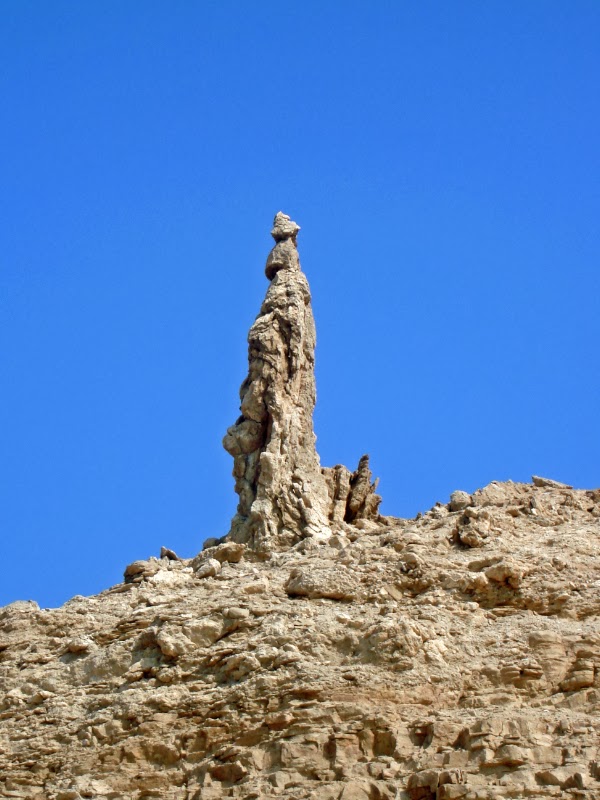
v.26 However Lot's lingering seems to have taken deeper root in his wife and she is unable to grasp even the concept of eternal life and "looked back", presumably returning to the wicked world. This return is a step too far. The Lord can, for a short season, tolerate us taking a bit longer to grasp principles and get to the temple but returning to our wicked ways or our former life will not be tolerated. Consider this statement from the Lord,
"No man having put his hand to the plough, and looking back, is fit for the kingdom of God" Luke 9:57-62
And thus, Lot's wife perishes in the destruction. The Lord was quite specific in wanting us to remember this particular tragic choice. When speaking of the last days to the Pharisees he says, "Remember Lot's wife." (Luke 17:32). And in the latter-days he repeated the instruction (cf Doctrine and Covenants 133:14-15). Speaking of Lot's wife, Elder Neal A. Maxwell said,
"Let us once and for all establish our residence in Zion and give up the summer cottage in Babylon" ("A Wonderful Flood of Light", BYU Devotional 26 March 1989)
On a lighter note, when I hear this story I am always reminded of the story from Thomas S Monson who related an experience of one youth sunday school teacher,
"The Sunday School teacher was describing how Lot's wife looked back and turned into a pillar of salt. Little Johnny was much interested. 'My mother looked back once while she was driving,' he explained, 'and she turned into a telephone pole!' " (Favorite Quotations from the Collection of Thomas S. Monson [Salt Lake City: Deseret Book Co., 1985], 23
v.27-28 Meanwhile where is Abraham?  In the place where he stood before the Lord and where he can also see all the cities of the plain. It can be only one place. Abraham is in the mountain. Of course we would not expect anything less of Abraham. But it has more significance.
v.29 This final summary of the story of Sodom and Lot has an interesting turn of phrase,
 "It came to pass that when God destroyed the cities of the plain, that God remembered Abraham and sent Lot out of the midst of the overthrow." 
Why did God set his hand to rescuing Lot? He remembered Abraham. On the face of it that seems to be a bit illogical. Lot was saved because Abraham was righteous and asked for Lot to be saved? Surely we cant rely on someone else to get us to heaven and partake of eternal life? Well in a way we can (cf Alma 10:22-23 the prayers of the righteous) but in a way, ultimately, no we cant...unless it is the Saviour.

And so the parable extends with Abraham is a type/symbol of both 1. our premortal Father in Heaven and 2. the Saviour, Jesus Christ, who was the only one to keep himself unspotted from this world.
As our Father in Heaven, he leads Lot (us) and guides Lot (us). While Lot is with him he protects Lot (us) and blesses Lot (us). When it comes time to separate from him and come to this mortal fallen world (see Genesis 13:10  "even as the garden of the Lord" -the plains where Lot first pitches his tent are compared to the Garden of Eden which Adam and Eve leave to enter the dark and dreary world) We are instructed to live in the world but not be of it. We must work to be an influence on the world rather than allow the world to influence us.
At some point holy messengers of God will give us a chance to set ourselves apart from the world, to be baptized and converted. It is not an easy process. We may lose loved ones on the way. We may take longer than is ideal but the ultimate goal is to gather to the temple and partake of the saving ordinances and covenants of the temple. And God in his mercy has provided a Saviour to plead on our behalf, to atone for our shortcomings as long as we never return to the wicked ways of the world. As if this was not enough consider the meaning of their names. Abraham is Father of a Multitude. Lot is a Covering. It would seem Lot's life was meant not only as a symbol of us but also as a reminder of the great covering sacrifice and Atonement that is necessary to our salvation.

We are instructed to gather to the temple. The temples are our refuge from destruction and our sanctuary of peace. But the Lord is aware that we are imperfect and is aware how slow we are to listen and how often we linger in error's gloomy way. He is merciful. He has provided a Saviour who pleads for us and whose sacrifice covers our sins of commission and our sins of omission. But we must never look back. Remember Lot and Remember Lot's wife.